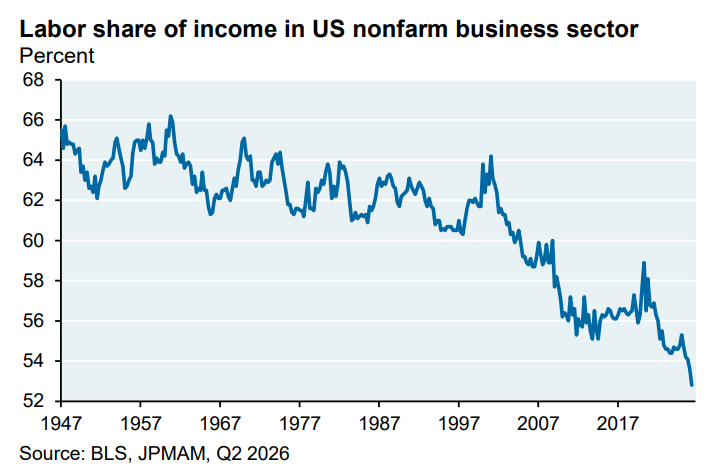
Labour's Share of US Output Just Hit Its Lowest Since 1947
For every dollar of output in the US nonfarm business sector, 53.0% now goes to workers, the lowest reading since the series began in 1947. It ran at 66% in the postwar years and was still near 64% around 2000. Since 2007 it has mostly gone one way.
The line gets used as evidence that the split between labour and capital has worsened. Part of it is not about the split at all, though. It is about the arithmetic.
The denominator is gross value added, which includes depreciation. When companies pour money into servers, chips and software, assets with short lives and fast write-downs, depreciation inflates the denominator and mechanically pushes labour's share down, even if nobody's pay has fallen. Goldman Sachs research estimates that roughly 40% of the 7.5-point decline since the 1990s comes from this effect.
These have been the heaviest capital-spending years on record, so that share of the explanation may be larger still for the most recent leg down.
One more thing worth remembering: this number gets revised. The second quarter was first published at 52.8%, then revised up to 53.3%, before the third quarter came in at 53.0%.
Strip out the measurement piece and the remaining four-point-plus decline is still real, and it has not turned.
Source: US Bureau of Labor Statistics productivity and costs release, J.P. Morgan Asset Management's long-run series, and Goldman Sachs research on how labour share is measured (Image: @MikeZaccardi)