【美國勞工拿走的那一份,掉到 1947 年以來最低 👷】
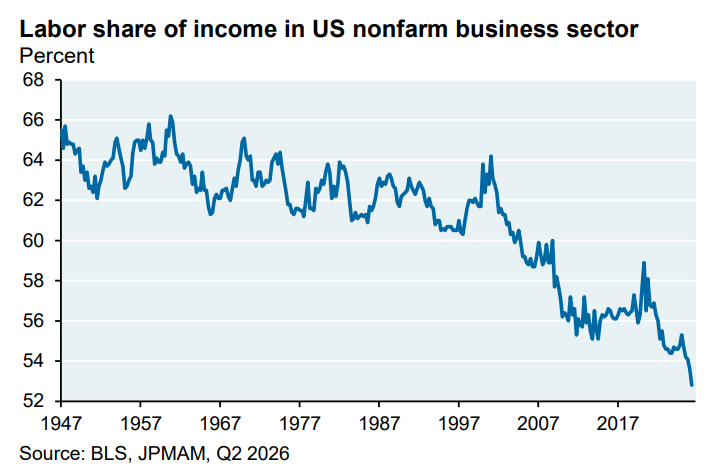
美國非農企業部門每做出一塊錢的產出,付給勞工的部分降到 53.0%,是 1947 年開始編這個數字以來的最低點。戰後一度有 66%,2000 年前後還有 64%,2007 年之後幾乎是一路往下。
這條線常被拿來當分配惡化的證據,不過其中有一塊不是分配問題,是算法問題。
這個比率的分母是毛附加價值,裡面含折舊。當企業把錢大量投在伺服器、晶片和軟體這類壽命短、折舊快的資本上,折舊金額會把分母撐大,勞動份額就自動被壓低,就算每個人的薪水一毛沒少也一樣。高盛的研究估算,1990 年代以來 7.5 個百分點的跌幅裡,大約四成來自這個效果。
這幾年正好是資本支出最猛的幾年,所以最近這一段下滑,受這個算法影響的比例可能還更高一點。
還有一件事值得記住:這個數字會修。第二季最早公布 52.8%,後來被修到 53.3%,第三季才又回到 53.0%。
把算法那一塊扣掉,剩下的四個多百分點仍然是真的,而且方向沒有轉。
資料來源:美國勞工統計局生產力與成本報告、摩根資產管理長期序列圖,以及高盛關於勞動份額衡量方式的研究(圖片來自 @MikeZaccardi)
Labour's Share of US Output Just Hit Its Lowest Since 1947
For every dollar of output in the US nonfarm business sector, 53.0% now goes to workers, the lowest reading since the series began in 1947. It ran at 66% in the postwar years and was still near 64% around 2000. Since 2007 it has mostly gone one way.
The line gets used as evidence that the split between labour and capital has worsened. Part of it is not about the split at all, though. It is about the arithmetic.
The denominator is gross value added, which includes depreciation. When companies pour money into servers, chips and software, assets with short lives and fast write-downs, depreciation inflates the denominator and mechanically pushes labour's share down, even if nobody's pay has fallen. Goldman Sachs research estimates that roughly 40% of the 7.5-point decline since the 1990s comes from this effect.
These have been the heaviest capital-spending years on record, so that share of the explanation may be larger still for the most recent leg down.
One more thing worth remembering: this number gets revised. The second quarter was first published at 52.8%, then revised up to 53.3%, before the third quarter came in at 53.0%.
Strip out the measurement piece and the remaining four-point-plus decline is still real, and it has not turned.
Source: US Bureau of Labor Statistics productivity and costs release, J.P. Morgan Asset Management's long-run series, and Goldman Sachs research on how labour share is measured (Image: @MikeZaccardi)