The Company With the Cheapest Copper Is Really Selling Gold
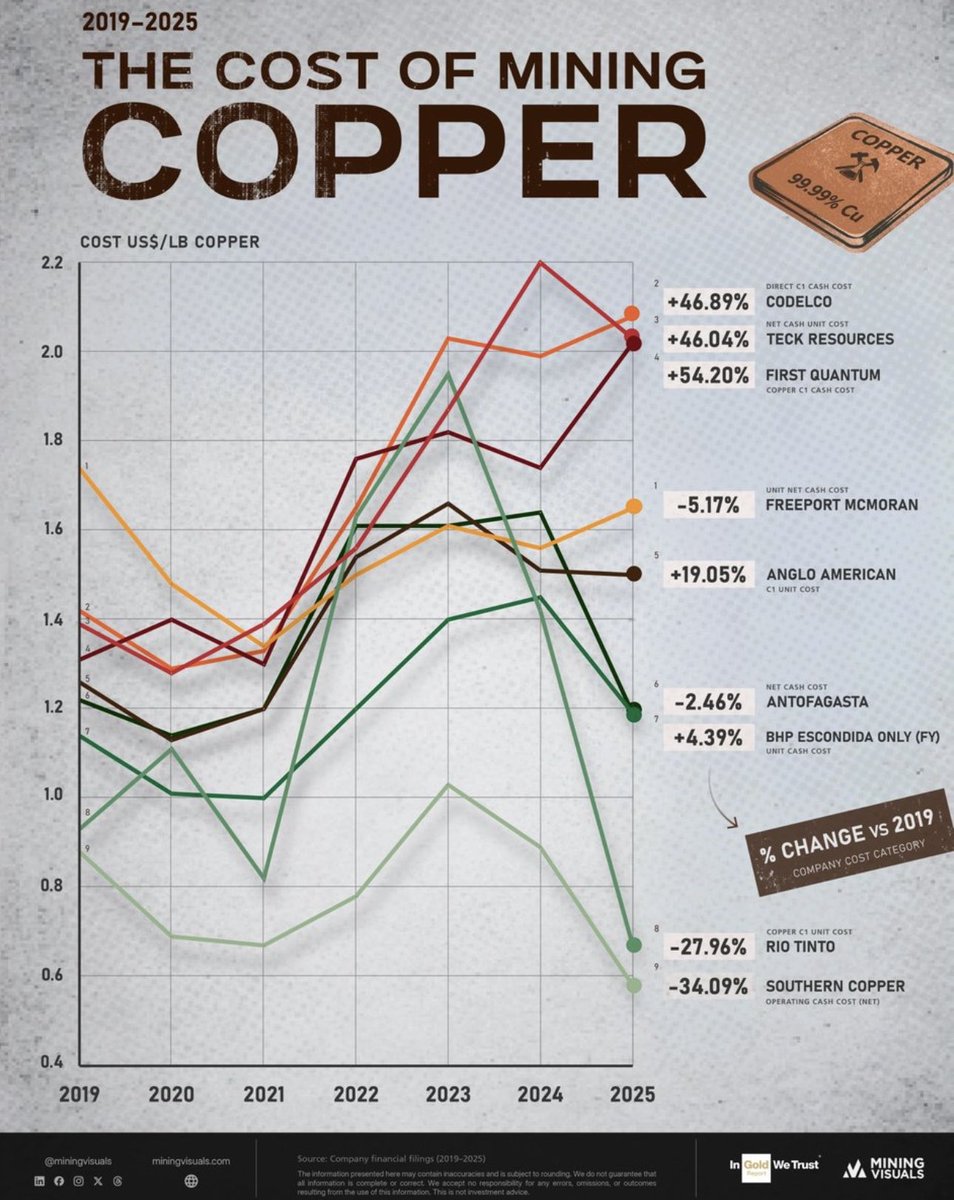
Between 2019 and 2025, First Quantum's cost per pound of copper rose 54%, Codelco's 47% and Teck's 46%. Over the same years Southern Copper's fell 34%, to about $0.58 a pound, and Rio Tinto's fell 28%.
Same metal, same period, and some costs up by half while others dropped by a third.
Part of the answer is in the small type beside each line: the companies are not using the same cost definition. Codelco reports a direct C1 cash cost. Southern Copper reports an operating cash cost, net. Freeport and Antofagasta report net cash costs. "Net" means the revenue from gold, silver and molybdenum pulled out of the same ore is subtracted first, and only what remains is charged to copper.
How much does that matter? Southern Copper's cost before those credits is about $2.17 a pound, the same neighbourhood as Codelco. The $1.60 that makes it look cheap comes from precious metal prices, not from mining efficiency. The accounting itself is standard across the industry. The problem is putting different definitions on one chart.
So half of this chart compares who mines well and the other half compares whose ore happens to contain something else. In years when gold sets records these companies' cost curves fall on their own, and when gold retreats the same costs climb back, with nothing at the mine having changed.
Source: unit cost disclosures in the miners' 2019 to 2025 financial filings, and mining cost research on how by-product credits are applied (Image: @jackprandelli)