【最會壓低銅礦成本的那家公司,靠的是賣黃金 ⛏️】
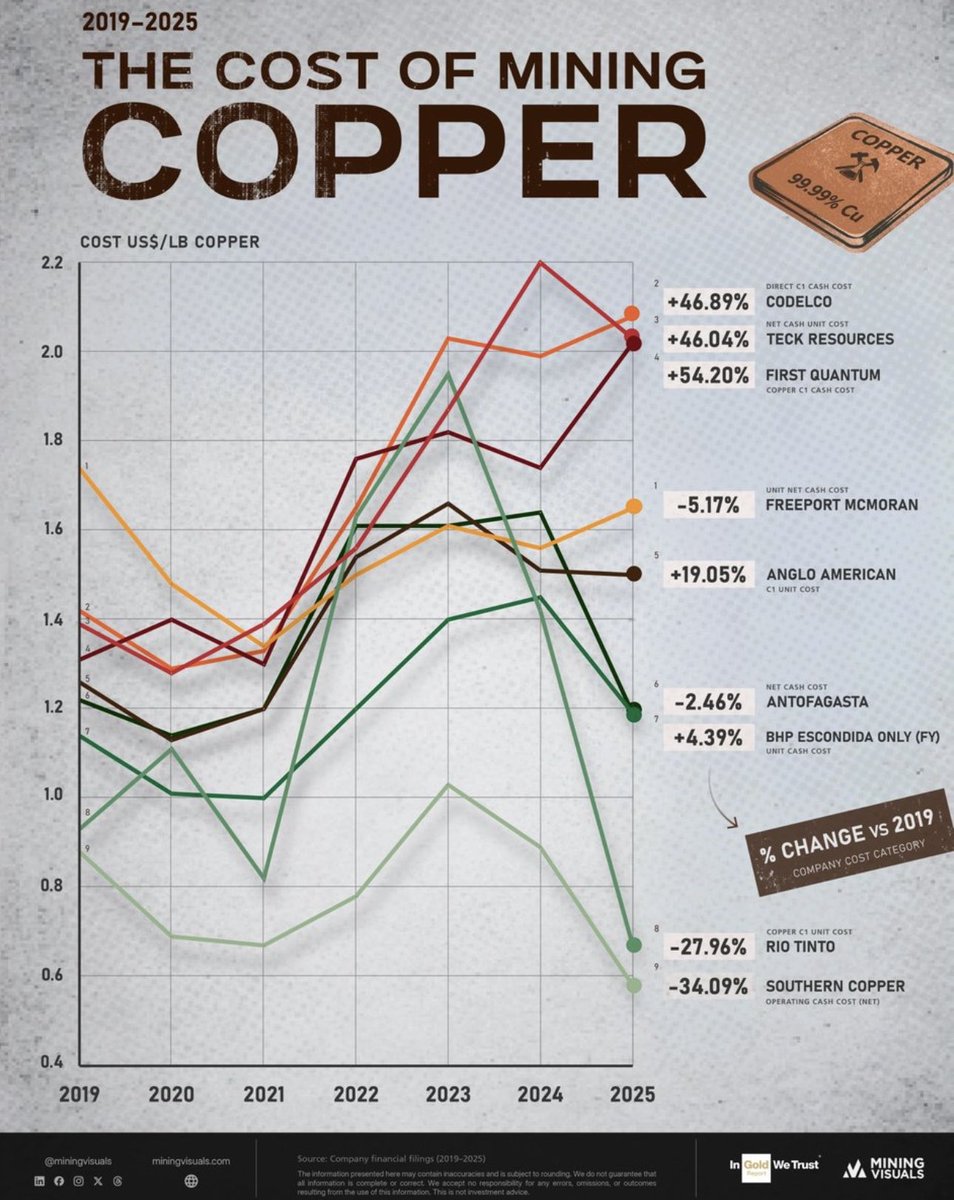
2019 到 2025 年,First Quantum 每磅銅的成本上升 54%,Codelco 上升 47%,Teck 上升 46%。同一段時間,南方銅業的成本下降 34%,降到每磅約 0.58 美元,力拓也下降 28%。
同樣是挖銅,有人成本漲五成,有人掉三成。
差別有一部分寫在每條線旁邊那行小字:各家用的成本定義不一樣。Codelco 標的是「直接 C1 現金成本」,南方銅業是「淨營運現金成本」,Freeport 和 Antofagasta 是「淨現金成本」。帶「淨」字的,意思是先把同一塊礦石裡產出的黃金、白銀、鉬賣掉的收入扣掉,剩下的才算在銅頭上。
這個差別有多大?南方銅業扣抵前的成本其實是每磅約 2.17 美元,跟 Codelco 同一個量級。它帳面上便宜的那 1.6 美元,是貴金屬的價格給的,不是挖礦效率給的。業界對這個算法的做法一致,問題只在於把不同定義畫在同一張圖上。
所以這張圖有一半在比誰會挖礦,另一半在比誰的礦裡還有別的金屬。金價創高的年份,這類公司的成本曲線會自己往下走;金價一回落,同一批公司的成本也會自己漲回去,礦場裡什麼都沒變。
資料來源:各礦業公司 2019 至 2025 年財報揭露的單位成本,以及礦業成本研究對副產品扣抵方式的說明(圖片來自 @jackprandelli)
The Company With the Cheapest Copper Is Really Selling Gold
Between 2019 and 2025, First Quantum's cost per pound of copper rose 54%, Codelco's 47% and Teck's 46%. Over the same years Southern Copper's fell 34%, to about $0.58 a pound, and Rio Tinto's fell 28%.
Same metal, same period, and some costs up by half while others dropped by a third.
Part of the answer is in the small type beside each line: the companies are not using the same cost definition. Codelco reports a direct C1 cash cost. Southern Copper reports an operating cash cost, net. Freeport and Antofagasta report net cash costs. "Net" means the revenue from gold, silver and molybdenum pulled out of the same ore is subtracted first, and only what remains is charged to copper.
How much does that matter? Southern Copper's cost before those credits is about $2.17 a pound, the same neighbourhood as Codelco. The $1.60 that makes it look cheap comes from precious metal prices, not from mining efficiency. The accounting itself is standard across the industry. The problem is putting different definitions on one chart.
So half of this chart compares who mines well and the other half compares whose ore happens to contain something else. In years when gold sets records these companies' cost curves fall on their own, and when gold retreats the same costs climb back, with nothing at the mine having changed.
Source: unit cost disclosures in the miners' 2019 to 2025 financial filings, and mining cost research on how by-product credits are applied (Image: @jackprandelli)