The Same 100bp Rate Rise Hurts Some Countries Twice as Much
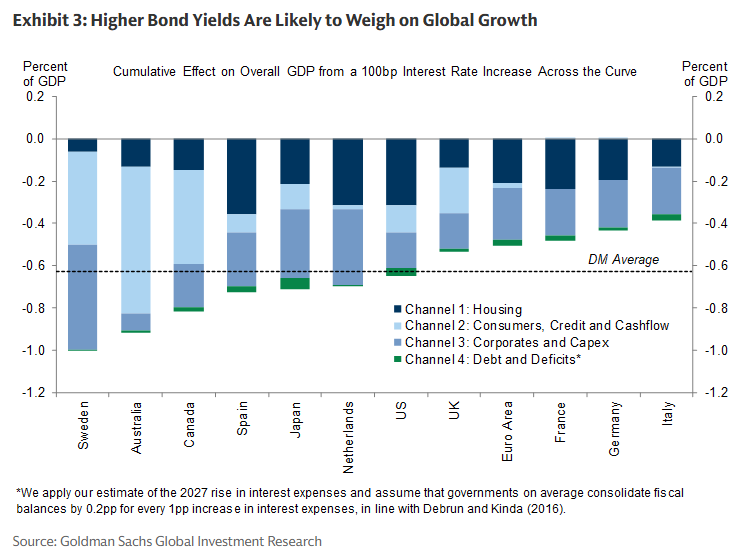
This model estimates the cumulative hit to GDP from a 100 basis point rise across the yield curve: about 1.0 percentage point for Sweden, 0.9 for Australia, 0.8 for Canada, 0.66 for the US and 0.63 for the developed-market average.
The spread has little to do with which country has the most expensive housing. It is about the route the money takes to reach households.
The chart splits the hit into four channels. For Australia, Sweden and Canada the biggest block is consumers, credit and cashflow, while housing investment is small. Their mortgages are mostly floating rate, so within months of a central bank move the monthly payment changes, disposable income drops immediately, and spending follows.
The US is shaped the other way round, with housing as the largest block. Thirty-year fixed mortgages lock in the cashflow of existing borrowers, so their payments do not move. The hit shows up in activity instead: people stop trading up, projects stall, and housing investment is estimated to fall around 8% over one to two years.
So the same rate shock becomes fewer supermarket trips in Australia and a frozen housing market in the US, where household spending feels it only much later. When reading across from another country's tightening cycle, check how its mortgages are priced before counting how many hikes it took.
This is one firm's model, and there is no settled method for splitting these channels, so the ranking is more useful than the decimals.
Source: Goldman Sachs October 2026 global outlook research on the GDP impact of higher yields by country (Image: @BlakeMillardCFA)