The Middle East Is Forecast to Grow 6.6% Next Year, Which Is Not a Recovery
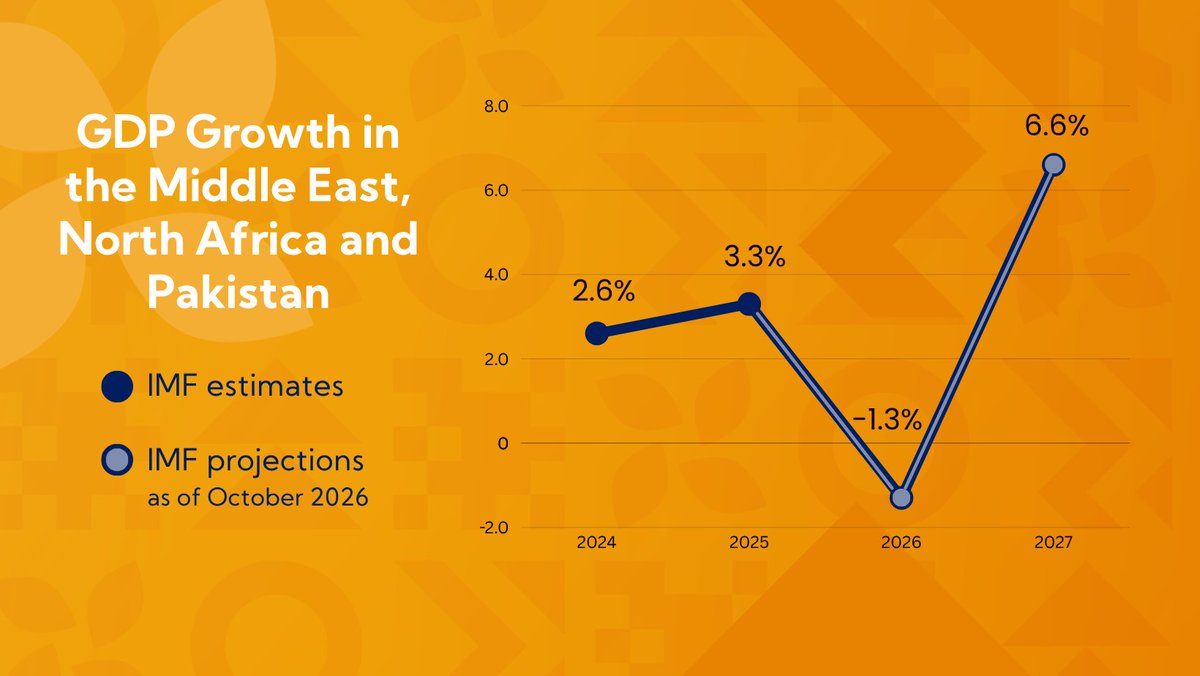
The IMF's October forecast has the Middle East, North Africa and Pakistan contracting 1.3% this year and rebounding to 6.6% next year. The V on the chart is hard to miss.
Work the numbers through and the right-hand side becomes clearer. Index 2025 at 100 and this year falls to 98.7. Multiply by 1.066 and next year reaches 105.2. Growing instead at 2025's 3.3% pace for two years would have reached 106.7. After the rebound, in other words, output is still below the path it would have been on without the war. The fund says as much itself.
The 6.6% also comes with a condition attached: that the fighting involving Iran eases. This year's -1.3% is nearly three percentage points below what was forecast in April. A number that moved that far in six months is not a promise about next year.
The spread within the region is wide. Most Gulf economies contract this year, with Bahrain, Kuwait, Qatar and Iraq projected to post double-digit declines and Oman among the few exceptions. Energy production, shipping, tourism and investment confidence were hit at once, which is why the damage concentrates in the oil producers.
A high growth rate is sometimes just a smaller denominator. The right half of this V is arithmetic, not repair.
Source: IMF World Economic Outlook, October 2026, and coverage of its regional projections (Image: @IMFNews)