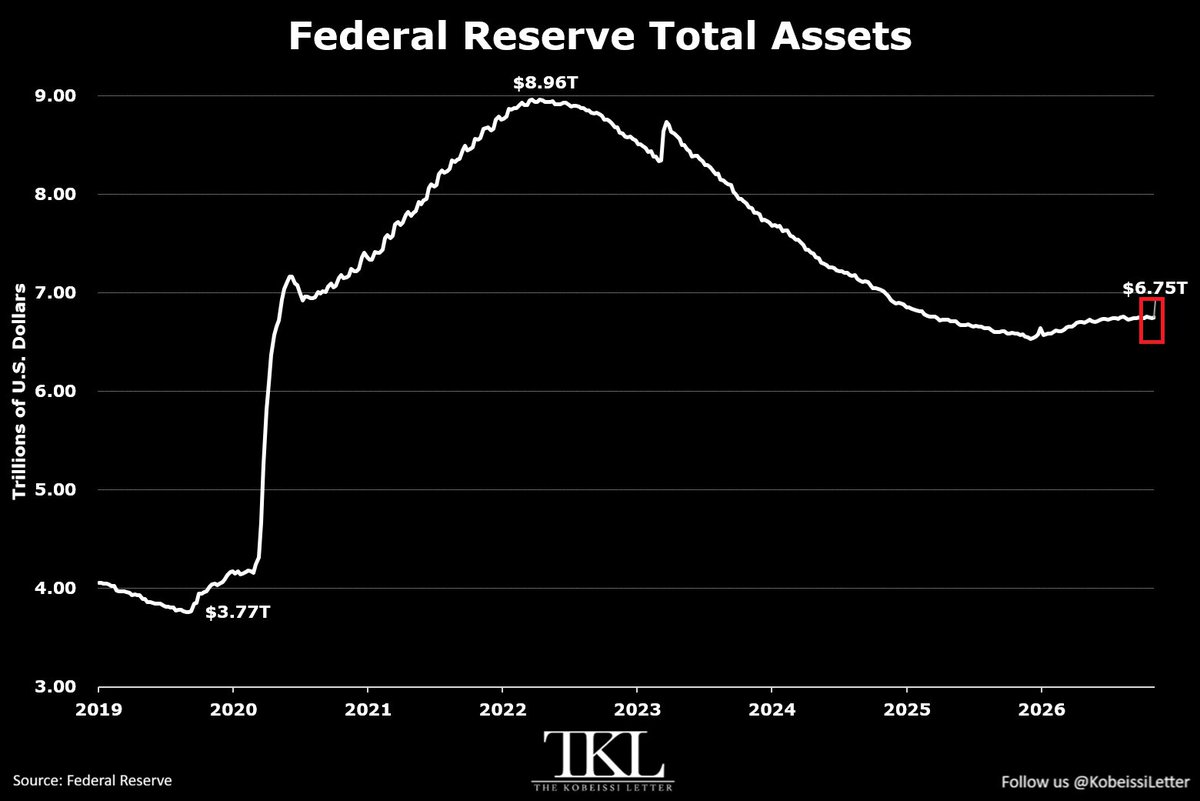
The Fed's Balance Sheet Is Growing Again
Total Federal Reserve assets are back to $6.75 trillion, about $212 billion above the low of December 2025. The 2022 peak was $8.96 trillion and the pre pandemic level was $3.77 trillion.
This is not a return to printing. The Fed ended roughly three and a half years of balance sheet shrinkage at the end of 2025 and began buying Treasury bills maturing within a year, with the aim of restoring bank reserves to an ample level rather than pushing down long term rates to stimulate the economy. The instruments differ, and so do the prices being targeted.
The composition makes it clearer. Over the same period Treasury holdings rose $390 billion to $4.58 trillion, the highest since March 2024, while mortgage backed securities fell $170 billion to $1.88 trillion, the lowest since June 2020. The total rose a little over two hundred billion, and underneath it is a swap: buying government debt while letting housing related holdings run off.
These reserve management purchases have also been paused for months. The Fed said in September and again in October that it would not buy bills for this purpose, citing ample liquidity in the banking system, with markets expecting purchases to resume in mid November. Growing again describes a process that stops and starts.
The line to watch is not the total. It is the level of reserves, which is what tells you whether the Fed is topping up passively or actually easing.
Source: Federal Reserve weekly balance sheet releases and Monetary Policy Report (Image: @KobeissiLetter)