The Grid Fits 12 Times More Load, If You Agree to Be Switched Off
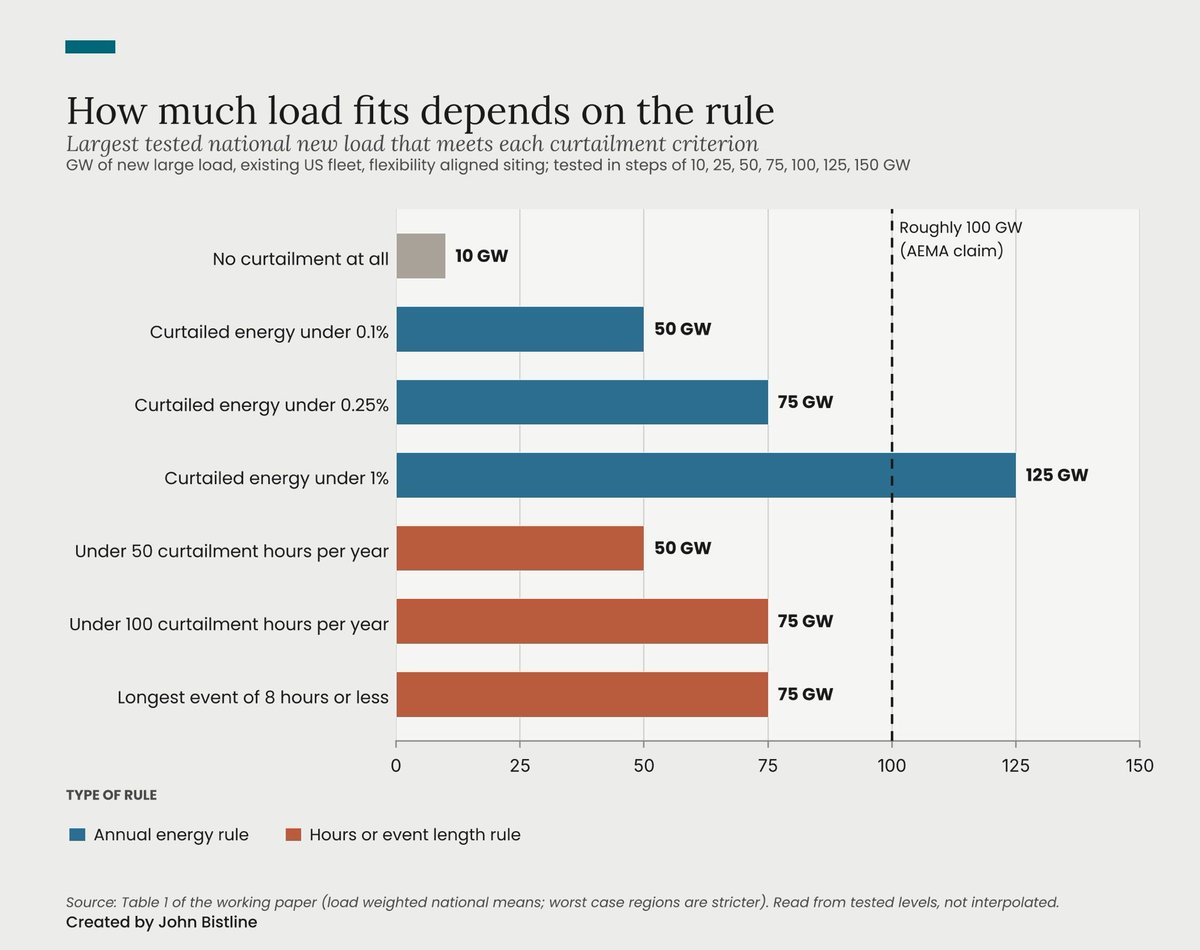
How much new large load the existing US grid can take depends almost entirely on how the rule is written. If a new user can never be curtailed, the country fits 10 GW. If it accepts losing 1% of its annual energy, it fits 125 GW.
Those 115 GW in between come from a signed agreement to be interrupted, not from new power plants.
The catch is that 1% of energy is not 1% of the time. The curtailed hours land on the hottest, tightest, most expensive days of the year. So a data centre does not need to use less power; it needs to carry itself through the few hours that matter most, and that cost shows up in generators, storage and dispatch contracts.
Rewrite the rule and the price becomes visible. Cap curtailment at 50 hours a year and the grid fits 50 GW. Cap any single event at 8 hours and it fits 75 GW. Limiting time costs far more than limiting volume, because the pain of an outage does not scale with its length.
These figures come from tested steps rather than a smooth curve, so 125 means that level passed, not a precise ceiling. The industry's 100 GW claim is not wrong, but it assumes the loosest rule.
Source: working paper on flexible interconnection for the US grid (Image: @JEBistline)