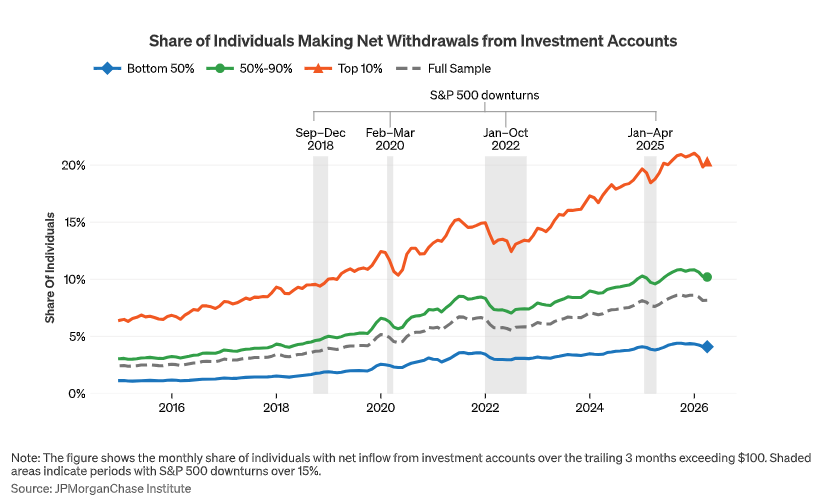
One in Five of America's Top Earners Is Now Drawing Down an Investment Account
Among the top 10% of US earners, 20.3% made net withdrawals from investment accounts during February to April 2026. In the same months of 2015, the figure was 6.6%.
The JPMorganChase Institute, tracking flows across its own customer base, finds the share rising at every wealth level. The full sample went from 2.4% in 2015 and 4.0% in 2019 to 8.2% in 2026, while people below median income went from 1.1% to 4.1%. The top decile has been the highest throughout, and it has pulled furthest away.
This is not wealthy households selling stocks. The footnote defines a withdrawal as a net outflow of more than $100 over the trailing three months, a threshold low enough that almost any routine transfer qualifies. The line measures how many people touch an investment account, not how much they take out. It also climbed steadily through the bull market years from 2016 to 2021, which is another sign it has little to do with market views.
What is driving it is a change in how retirement is funded. The same study shows 37% of top-earning retirees making net withdrawals in 2025, up from 24.5% in 2019, with investment accounts covering 15% of their spending against 8% before. As defined-benefit pensions give way to defined-contribution plans, retirement income stops arriving automatically each month and becomes a decision about what to sell and when.
Across all households, investment accounts now fund 6.8% of US consumer spending, against 2.3% in 2015. American consumption has become more directly linked to the stock market. A falling market used to dent consumer confidence. It now reduces the balance households were about to spend.
Source: the JPMorganChase Institute (Image: @RyanDetrick)