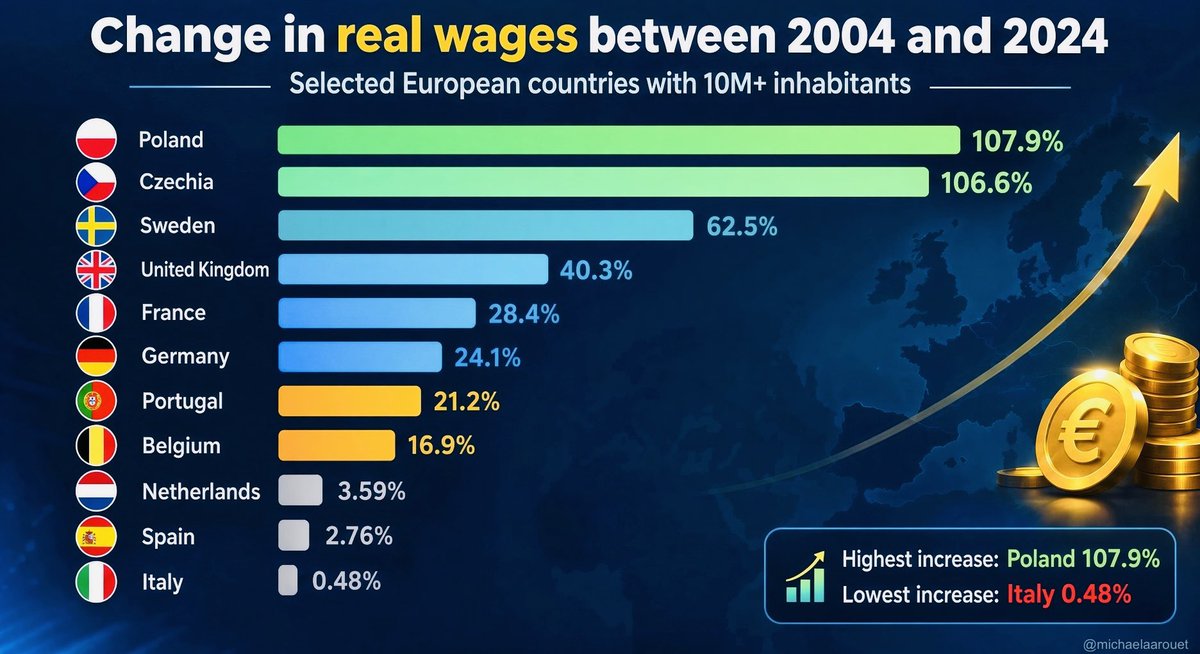
Polish Real Wages Doubled in Twenty Years. Italian Wages Barely Moved
Between 2004 and 2024, real wages in Poland rose 107.9%. In Italy they rose 0.48%.
The ranking covers European countries with more than 10 million people. Poland at 107.9% and Czechia at 106.6% sit at the top, Sweden at 62.5% and the United Kingdom at 40.3% in the middle, then Germany at 24.1%, the Netherlands at 3.59% and Spain at 2.76%, with Italy last.
The 2004 starting point is not arbitrary. Poland and Czechia both joined the European Union that May, opening tariffs, capital flows and supply chains at once, and wages climbed from a low base. The chart measures catching up rather than overtaking. OECD data shows Italy as the weakest performer among the large member economies, with net hourly pay still below its 1996 level as of 2023.
Even after doubling, Polish workers earn less than Italian ones. On the OECD's purchasing-power-adjusted measure of average annual wages, Italy stood at $51,019 in 2024 against Poland's $44,211. The gap has narrowed without closing.
Growth rates and living standards are separate questions. Italians on wages that have barely moved still take home more in absolute terms than Poles whose pay has doubled. And Poland's twenty-year climb has already been enough to redirect where labour moves across central Europe, long before the two lines cross.
Source: OECD average annual wages data and Visual Capitalist (Image: @MichaelAArouet)