【波蘭實質薪水二十年翻倍,義大利幾乎沒動】💶
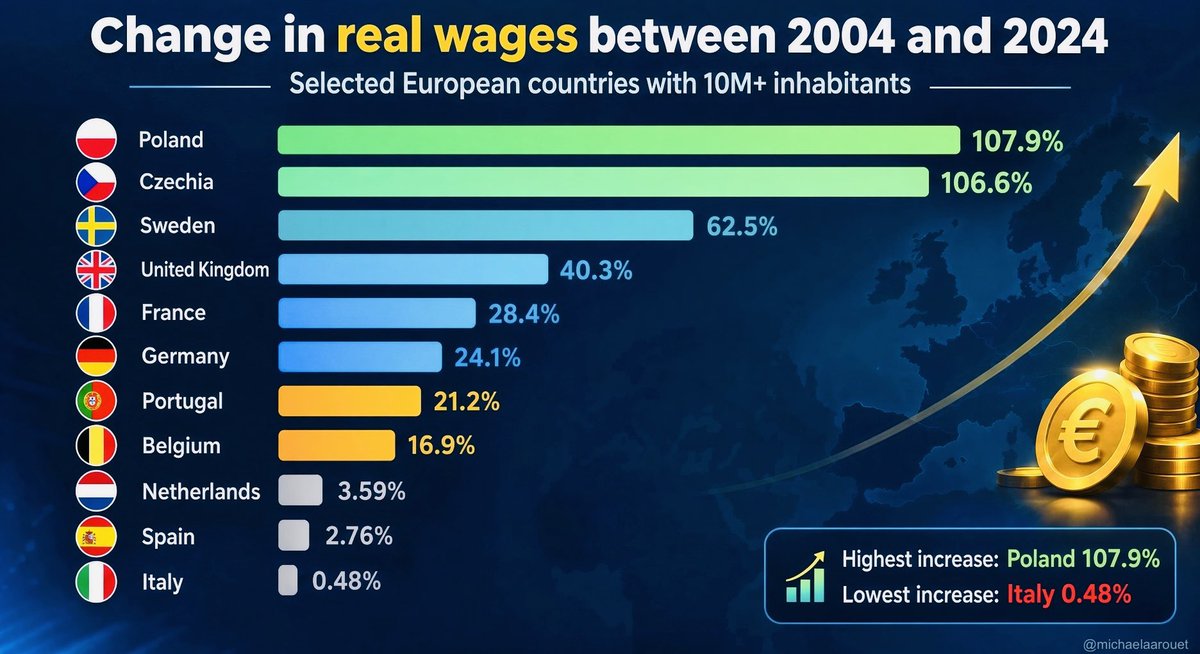
2004 到 2024 這二十年,波蘭的實質薪資成長了 107.9%,義大利只有 0.48%。
這份排行比較的是歐洲人口超過 1,000 萬的國家。波蘭 107.9%、捷克 106.6% 排在最前面,瑞典 62.5%、英國 40.3% 居中,德國 24.1%、荷蘭 3.59%、西班牙 2.76% 往下,義大利敬陪末座。
起點選在 2004 年不是隨意的。波蘭與捷克都在那一年 5 月加入歐盟,關稅、資金與供應鏈同時打開,薪資從偏低的基期往上追。這條線量的是追趕,不是超車。經濟合作暨發展組織的資料顯示,義大利則是大型成員國裡表現最差的一個,淨時薪到 2023 年仍低於 1996 年的水準。
翻倍之後,波蘭人的薪水還是比義大利人低。按經濟合作暨發展組織以購買力平價計算的平均年薪,義大利 2024 年為 51,019 美元,波蘭是 44,211 美元。差距縮小了,但還沒交叉。
成長率和生活水準是兩個問題。義大利人拿著幾乎沒動的薪水,絕對金額仍高於一路翻倍的波蘭人;而波蘭這二十年的曲線,在真正追平之前就已經足以改變整個中歐的勞動力流向。
資料來源: 經濟合作暨發展組織平均年薪資料、Visual Capitalist (圖片來自 @MichaelAArouet)
Polish Real Wages Doubled in Twenty Years. Italian Wages Barely Moved
Between 2004 and 2024, real wages in Poland rose 107.9%. In Italy they rose 0.48%.
The ranking covers European countries with more than 10 million people. Poland at 107.9% and Czechia at 106.6% sit at the top, Sweden at 62.5% and the United Kingdom at 40.3% in the middle, then Germany at 24.1%, the Netherlands at 3.59% and Spain at 2.76%, with Italy last.
The 2004 starting point is not arbitrary. Poland and Czechia both joined the European Union that May, opening tariffs, capital flows and supply chains at once, and wages climbed from a low base. The chart measures catching up rather than overtaking. OECD data shows Italy as the weakest performer among the large member economies, with net hourly pay still below its 1996 level as of 2023.
Even after doubling, Polish workers earn less than Italian ones. On the OECD's purchasing-power-adjusted measure of average annual wages, Italy stood at $51,019 in 2024 against Poland's $44,211. The gap has narrowed without closing.
Growth rates and living standards are separate questions. Italians on wages that have barely moved still take home more in absolute terms than Poles whose pay has doubled. And Poland's twenty-year climb has already been enough to redirect where labour moves across central Europe, long before the two lines cross.
Source: OECD average annual wages data and Visual Capitalist (Image: @MichaelAArouet)