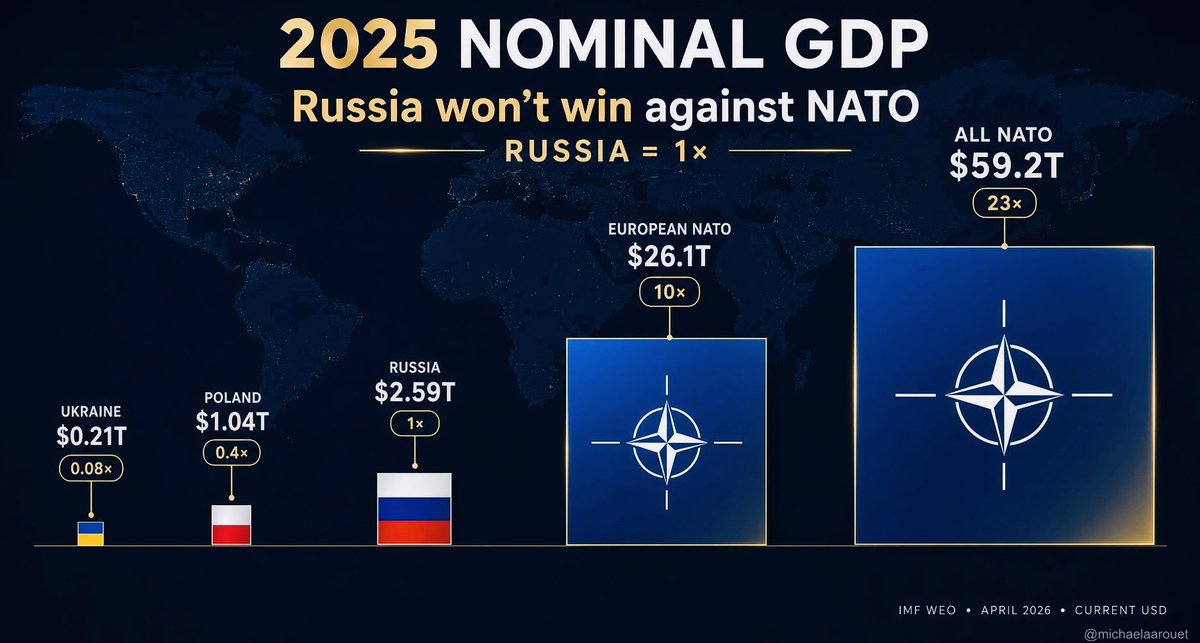
At Market Exchange Rates, Russia's Economy Is One Forty-Third of NATO's
Converted at market exchange rates, NATO's combined nominal GDP in 2025 was $59.2 trillion against Russia's $2.59 trillion, a ratio of 23 to one.
The figures come from the International Monetary Fund's April World Economic Outlook, in current dollars. European NATO members alone total $26.1 trillion, ten times Russia's economy. Poland by itself reaches $1.04 trillion, about four-tenths of the Russian total.
Exchange rates measure what a ruble fetches on currency markets, not what it buys inside Russia. Military production consumes domestic steel, electricity, engineers and factory hours, all priced in local terms. When the International Institute for Strategic Studies recalculated on a purchasing-power basis in its Military Balance, Russia's 2024 defence spending came to roughly $462 billion, above the $457 billion spent by the European Union and the United Kingdom combined. A rounding error in nominal dollars turns out to be the same order of magnitude in actual output.
The adjustment cuts both ways. Applying the same method to lower-cost members such as Poland, Italy, Turkey and Spain lifts European NATO's defence budget to around $687 billion. The gap survives the adjustment; it just stops being 23 to one.
The exchange rate you pick decides whether you have measured the size of an economy or its actual output. Nominal figures work for comparing how big economies are, but judging how much a country can physically build requires the purchasing-power measure, applied to both sides.
Source: IMF World Economic Outlook, the IISS Military Balance and World Economics (Image: @MichaelAArouet)