【用匯率換算,俄羅斯經濟只有北約的四十三分之一】🧭
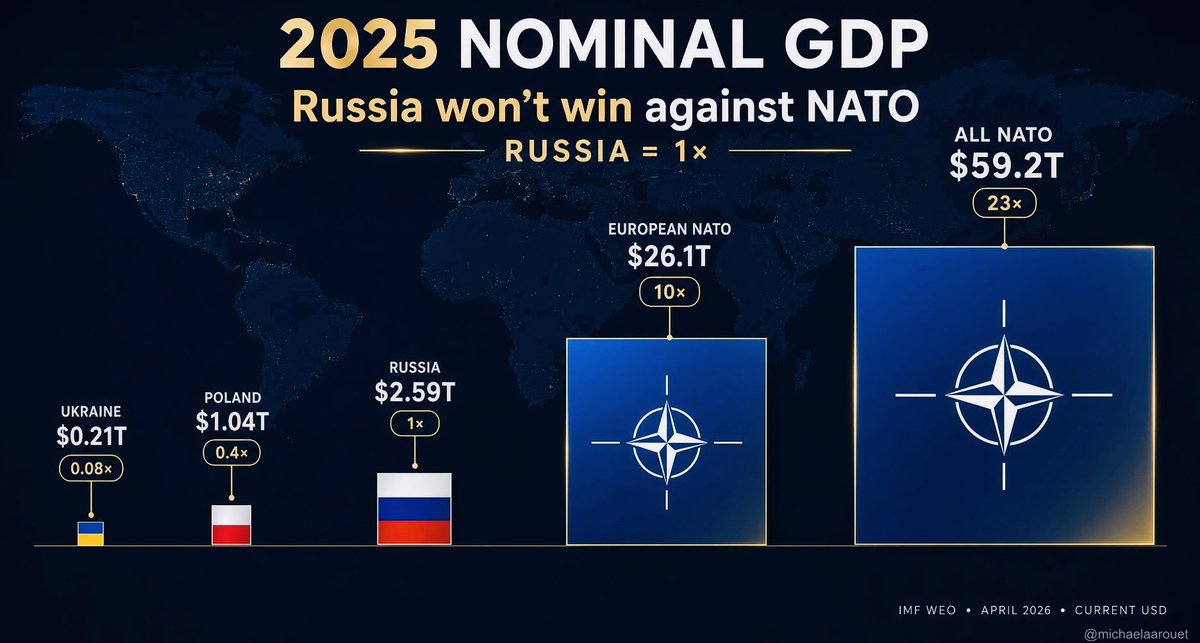
按市場匯率換算,北約全體 2025 年的名目國內生產毛額是 59.2 兆美元,俄羅斯是 2.59 兆美元,相差 23 倍。
這組數字來自國際貨幣基金今年 4 月的世界經濟展望,以當期美元計價。光是歐洲的北約成員國合計就有 26.1 兆美元,是俄羅斯的 10 倍;波蘭一國 1.04 兆美元,相當於俄羅斯的四成。
但匯率換算的是盧布在外匯市場上值多少,不是盧布在俄羅斯國內買得到多少。軍工生產用的是本地的鋼鐵、電力、工程師與工廠工時,這些成本按國內物價計算。國際戰略研究所的《軍事平衡》以購買力平價重算後發現,俄羅斯 2024 年的國防支出約當 4,620 億美元,已經超過歐盟加英國合計的 4,570 億美元。以名目美元看是零頭,以實際買得到的產能看是同一個量級。
反過來也要算。同樣的購買力調整套用在波蘭、義大利、土耳其、西班牙這些成本較低的成員國身上,歐洲北約整體的國防預算相當於約 6,870 億美元。調整之後,規模差距仍然存在,只是不再是 23 倍。
選哪一種匯率,決定了算出來的是經濟規模還是實際產能。名目數字適合比較經濟體的大小,要判斷一個國家能實際生產多少東西,得換成購買力口徑,而且兩邊都要換。
資料來源: 國際貨幣基金世界經濟展望、國際戰略研究所《軍事平衡》、World Economics (圖片來自 @MichaelAArouet)
At Market Exchange Rates, Russia's Economy Is One Forty-Third of NATO's
Converted at market exchange rates, NATO's combined nominal GDP in 2025 was $59.2 trillion against Russia's $2.59 trillion, a ratio of 23 to one.
The figures come from the International Monetary Fund's April World Economic Outlook, in current dollars. European NATO members alone total $26.1 trillion, ten times Russia's economy. Poland by itself reaches $1.04 trillion, about four-tenths of the Russian total.
Exchange rates measure what a ruble fetches on currency markets, not what it buys inside Russia. Military production consumes domestic steel, electricity, engineers and factory hours, all priced in local terms. When the International Institute for Strategic Studies recalculated on a purchasing-power basis in its Military Balance, Russia's 2024 defence spending came to roughly $462 billion, above the $457 billion spent by the European Union and the United Kingdom combined. A rounding error in nominal dollars turns out to be the same order of magnitude in actual output.
The adjustment cuts both ways. Applying the same method to lower-cost members such as Poland, Italy, Turkey and Spain lifts European NATO's defence budget to around $687 billion. The gap survives the adjustment; it just stops being 23 to one.
The exchange rate you pick decides whether you have measured the size of an economy or its actual output. Nominal figures work for comparing how big economies are, but judging how much a country can physically build requires the purchasing-power measure, applied to both sides.
Source: IMF World Economic Outlook, the IISS Military Balance and World Economics (Image: @MichaelAArouet)