When Machines Took the Cobbler's Trade, the Veterans Kept Working and the Young Stopped Arriving
Across the decades when machines remade British bootmaking, total employment in the trade barely fell.
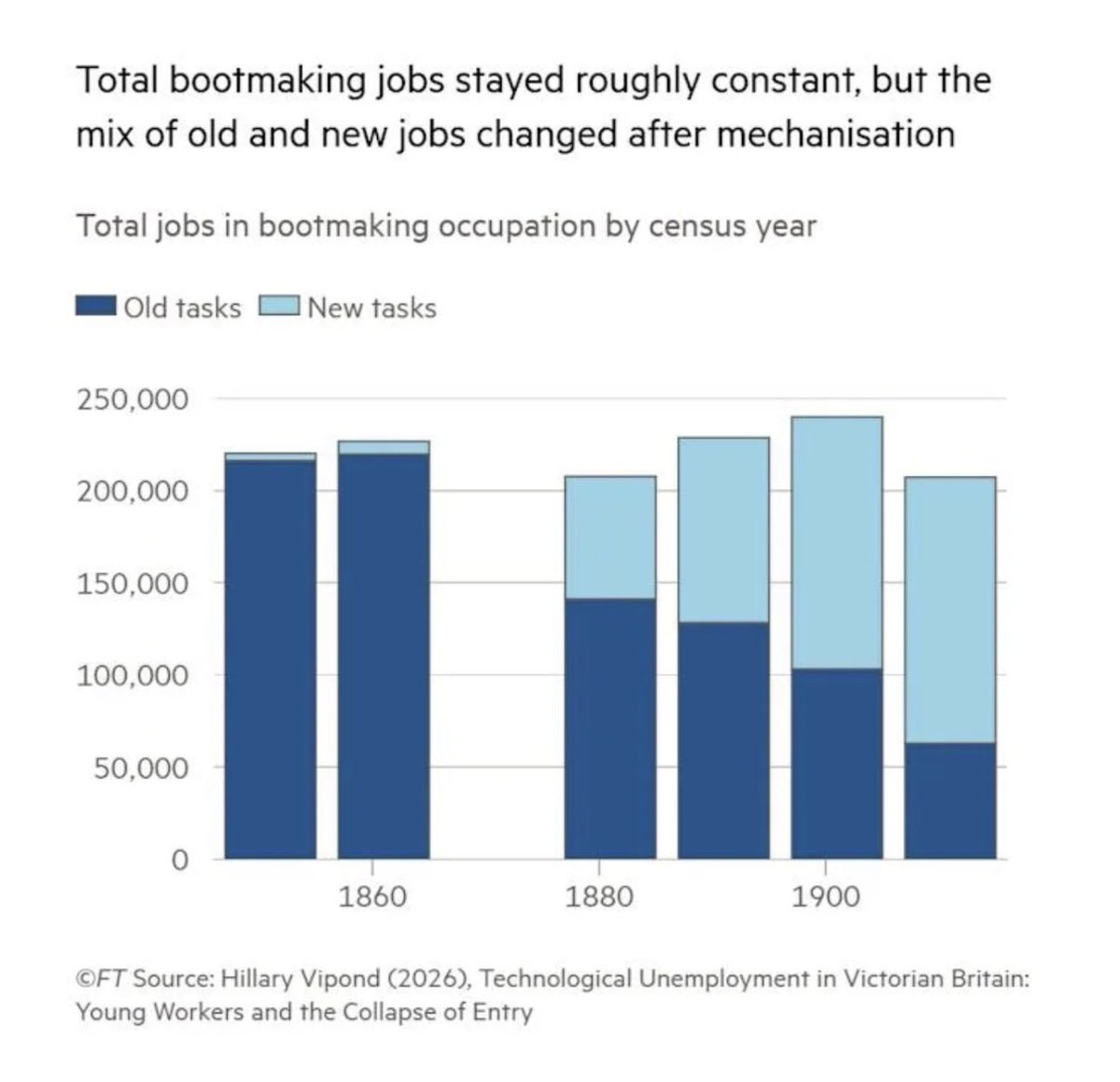
Census records from 1851 to 1911 show the number of bootmaking jobs holding between roughly 200,000 and 240,000. Inside that total, everything changed. Roles built on hand craft fell from about 215,000 to 63,000, and roles that only existed because of the machines filled the gap.
What changed was not the position of the old craftsmen but the position of anyone trying to get in. Hillary Vipond, an economic historian at the London School of Economics, tracked individual careers through 170 million census records and found that established artisans were neither pushed out in large numbers nor moved across to the new work. The old trade shrank because young men stopped entering it. She calls this the collapse of entry.
The new jobs did not appear where the old ones vanished, either. The 153,000 artisanal positions that disappeared were spread across every county in England, while the 140,000 new positions clustered in Leicestershire and Northamptonshire. For a bootmaker in middle age, the opportunity existed about two hundred kilometres away.
Holding the total steady came at a price: the entire adjustment landed on the generation that had not yet started, and reaching the new work meant moving to a different town.
Source: Hillary Vipond (2026) research paper, the Financial Times and the LSE Economic History blog (Image: @AzizSunderji)