【機器取代工匠那次,老師傅沒失業,年輕人進不來】👞
英國製靴業被機器改造的那幾十年,總就業人數幾乎沒有減少。
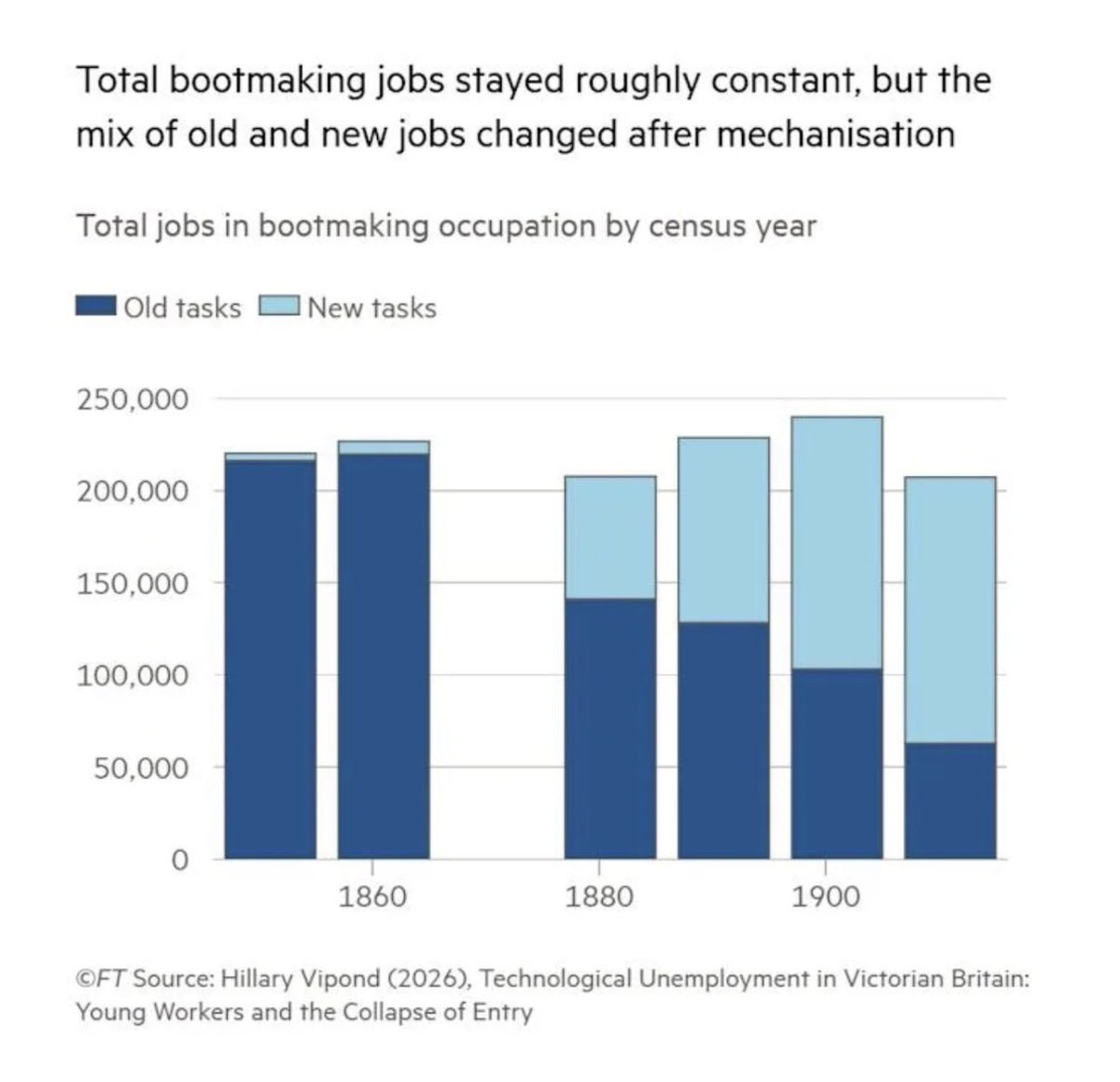
1851 到 1911 年的歷次人口普查顯示,製靴業的職缺總數一直在 20 萬到 24 萬之間,但內部結構整個翻了過來。靠手工技藝的舊工序從大約 21.5 萬人掉到 6.3 萬人,機器時代才出現的新工序補上了缺口。
被改變的不是老工匠,是想入行的人。倫敦政經學院經濟史學者 Hillary Vipond 用 1.7 億筆普查紀錄追蹤個人職涯,發現原本的手工師傅既沒有大量失業,也幾乎沒有轉去做新工作。舊工序的萎縮,是靠年輕男性不再進入這一行完成的。她把這個現象稱為「入口崩塌」。
新工作也不是在原地長出來。消失的 15.3 萬個手工職缺遍布英格蘭每一個郡,新增的 14 萬個工作卻集中在萊斯特郡和北安普敦郡。對一個中年鞋匠而言,新機會確實存在,只是在兩百公里以外。
總數持平的代價,是調整全部壓在還沒進門的那一代人身上,而且要換一座城市才拿得到。
資料來源: Hillary Vipond(2026)研究論文、金融時報、倫敦政經學院經濟史網誌 (圖片來自 @AzizSunderji)
When Machines Took the Cobbler's Trade, the Veterans Kept Working and the Young Stopped Arriving
Across the decades when machines remade British bootmaking, total employment in the trade barely fell.
Census records from 1851 to 1911 show the number of bootmaking jobs holding between roughly 200,000 and 240,000. Inside that total, everything changed. Roles built on hand craft fell from about 215,000 to 63,000, and roles that only existed because of the machines filled the gap.
What changed was not the position of the old craftsmen but the position of anyone trying to get in. Hillary Vipond, an economic historian at the London School of Economics, tracked individual careers through 170 million census records and found that established artisans were neither pushed out in large numbers nor moved across to the new work. The old trade shrank because young men stopped entering it. She calls this the collapse of entry.
The new jobs did not appear where the old ones vanished, either. The 153,000 artisanal positions that disappeared were spread across every county in England, while the 140,000 new positions clustered in Leicestershire and Northamptonshire. For a bootmaker in middle age, the opportunity existed about two hundred kilometres away.
Holding the total steady came at a price: the entire adjustment landed on the generation that had not yet started, and reaching the new work meant moving to a different town.
Source: Hillary Vipond (2026) research paper, the Financial Times and the LSE Economic History blog (Image: @AzizSunderji)