Years of Rate Hikes Left US Companies Paying Less Interest
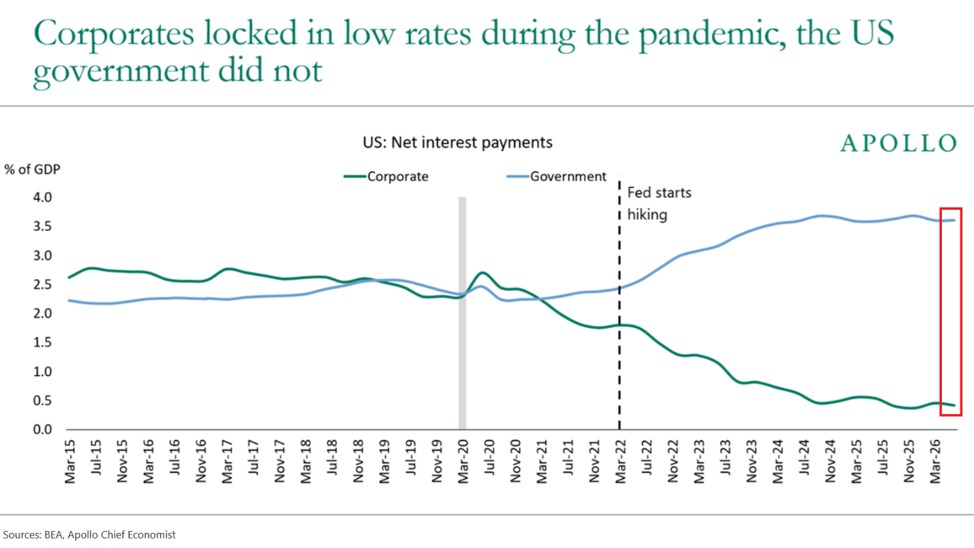
Net interest payments by US corporates have fallen from about 2.5% of GDP in 2015 to 0.4% in the second quarter of this year. Over the same stretch, government net interest payments rose from about 2.2% to 3.6%. The two lines cross at the point where the Federal Reserve started hiking in 2022.
The two sides made opposite decisions when money was free. Companies issued long-dated fixed-rate bonds through the pandemic and locked cheap funding in for a decade. The Treasury did not extend the maturity of its debt while it had the chance, leaving a heavy weighting in short paper where the interest bill moves almost as soon as the policy rate does.
It is worth noticing that this is net interest. Corporate cash piles have been earning 4% to 5%, and that income is netted against what companies pay out, so 0.4% flatters the picture relative to interest actually paid. Large cash-rich firms benefit most, and smaller borrowers genuinely paying high rates are averaged away inside the line.
This also answers something that has puzzled people since 2022, which is why the tightening cycle did so little to slow the economy. The cost did not disappear. It landed on the fiscal side instead.
Locked-in rates expire. As pandemic-era bonds roll into new coupons the green line turns back up, and the first to feel it are the leveraged borrowers with the least cash. Where the line sits today is not a structural advantage. It is a cushion partway through being used.
Source: US Bureau of Economic Analysis and research by Torsten Sløk, chief economist at Apollo Global Management (Image: @KobeissiLetter)