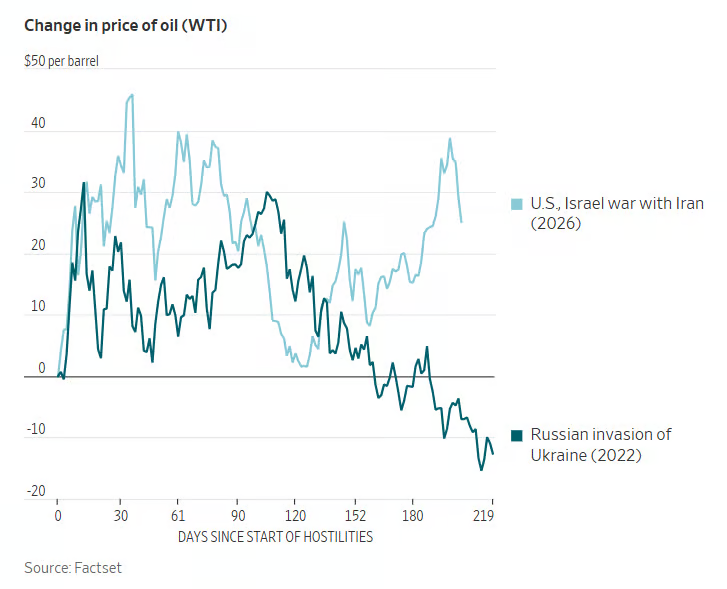
Two Wars, 219 Days In, and Oil Went Opposite Ways
Two hundred and nineteen days after Russia invaded Ukraine, West Texas crude was cheaper than it had been before the war started. At the same point after the US and Israel went to war with Iran, oil is still about $24 a barrel above its pre-war level.
The obvious reading is that this war is the more serious one. The supply numbers say the opposite is the surprise. The European Central Bank estimated in July that the Iran conflict disrupted roughly 14 million barrels a day, about 14% of global supply, against roughly 1 million a day during the Ukraine war. Fourteen times the disruption for $24 a barrel means the question is not why oil is still elevated. It is why oil is not far more expensive.
The answer predates the first shot. The market entered 2026 with a surplus of about 2.5 million barrels a day, where early 2022 had a deficit of about 1 million. Chinese crude stockpiles at one point covered around 115 days of imports. Governments released 400 million barrels from strategic reserves, more than double the 182 million released in 2022.
Every one of those cushions is a one-off. Inventory drawn down is gone, and refilling a strategic reserve means buying at today's prices. The US reserve is already at its lowest level since 1982.
So the $24 on this chart is not the shock itself. It is what was left after the buffers had done their work. A disruption of the same size next time would land on much less padding.
Source: European Central Bank research blog, Federal Reserve Bank of Chicago and FactSet (Image: @dailychartbook)