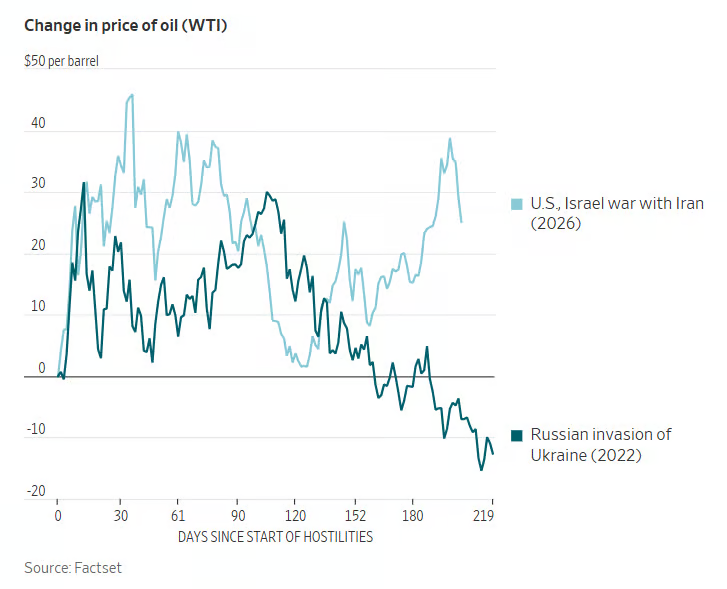
【兩場戰爭打到第 219 天,油價走成相反的樣子】🛢️
俄羅斯入侵烏克蘭後第 219 天,西德州原油已經比開戰前便宜。美國與以色列對伊朗開戰同樣天數,油價還高出約 24 美元。
直覺會說這場戰爭比較嚴重,但缺口大小其實要反過來看。歐洲央行 7 月的分析估計,伊朗這場衝突影響約每日 1,400 萬桶原油,相當於全球供給的 14%;俄烏那次大約是每日 100 萬桶。少了 14 倍的量,價格只高出 24 美元,該問的不是為什麼還沒跌,是為什麼沒有更貴。
答案在開打之前。2026 年初的原油市場是每日約 250 萬桶的供給過剩,2022 年初則是每日 100 萬桶的短缺。中國的原油庫存一度相當於 115 天的進口量。各國合計釋出 4 億桶戰備儲油,是 2022 年那次 1.82 億桶的兩倍以上。
這些緩衝都是一次性的。庫存放掉就沒了,戰備儲油要補回來得用現在的價格買,而美國的戰備儲油已經降到 1982 年以來最低。
所以圖上這 24 美元不是衝擊本身,是所有緩衝都用過一輪之後剩下來的部分。下一次同樣規模的事情,底下能墊的東西少很多。
資料來源: 歐洲央行研究部落格、芝加哥聯準銀行、FactSet (圖片來自 @dailychartbook)
Two Wars, 219 Days In, and Oil Went Opposite Ways
Two hundred and nineteen days after Russia invaded Ukraine, West Texas crude was cheaper than it had been before the war started. At the same point after the US and Israel went to war with Iran, oil is still about $24 a barrel above its pre-war level.
The obvious reading is that this war is the more serious one. The supply numbers say the opposite is the surprise. The European Central Bank estimated in July that the Iran conflict disrupted roughly 14 million barrels a day, about 14% of global supply, against roughly 1 million a day during the Ukraine war. Fourteen times the disruption for $24 a barrel means the question is not why oil is still elevated. It is why oil is not far more expensive.
The answer predates the first shot. The market entered 2026 with a surplus of about 2.5 million barrels a day, where early 2022 had a deficit of about 1 million. Chinese crude stockpiles at one point covered around 115 days of imports. Governments released 400 million barrels from strategic reserves, more than double the 182 million released in 2022.
Every one of those cushions is a one-off. Inventory drawn down is gone, and refilling a strategic reserve means buying at today's prices. The US reserve is already at its lowest level since 1982.
So the $24 on this chart is not the shock itself. It is what was left after the buffers had done their work. A disruption of the same size next time would land on much less padding.
Source: European Central Bank research blog, Federal Reserve Bank of Chicago and FactSet (Image: @dailychartbook)