China's Gains in Europe Came Almost Entirely Out of Cheap Cars
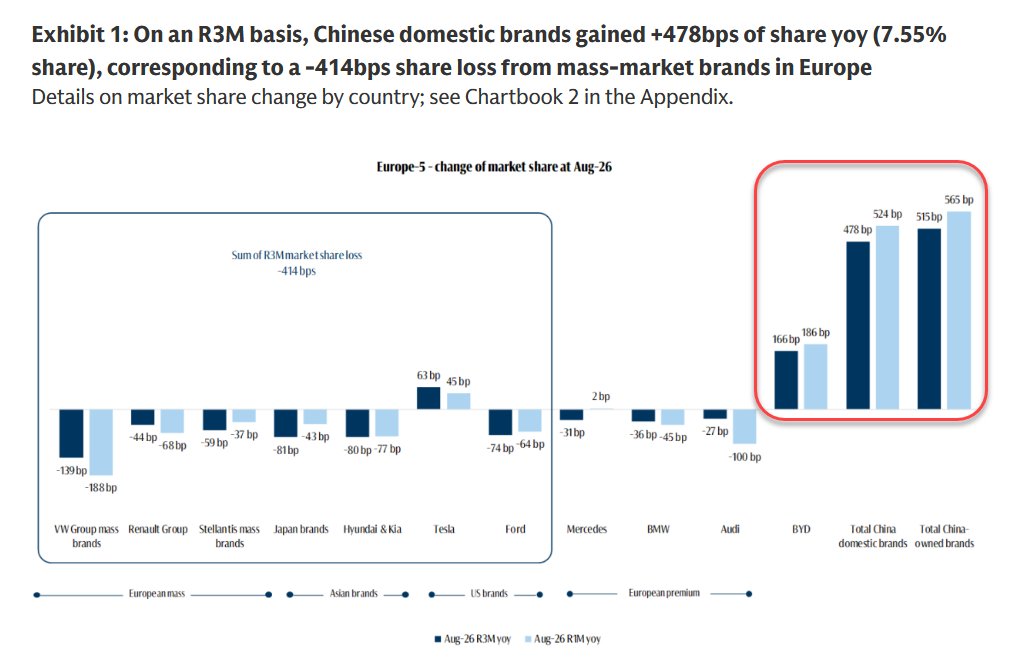
Over the three months to August, Chinese domestic brands gained 478 basis points of share across Europe's five largest car markets, reaching 7.55%. European mass-market brands lost 414 basis points over the same period, with Volkswagen Group's mass-market brands alone down 139.
Premium barely moved. Mercedes lost 31 basis points, BMW 36 and Audi 27, a fraction of Volkswagen's decline, while Tesla gained 63. What is being replaced sits around the €20,000 mark, not the whole market.
The shape of that outcome follows the shape of the tariffs. The EU imposed countervailing duties on China-built battery electric vehicles at the end of 2024, at 17% for BYD, 18.8% for Geely and 35.3% for SAIC. Plug-in hybrids were left out and still pay only the standard 10% import duty. Chinese brands redirected accordingly, and more than a third of Europe's plug-in hybrid sales now come from China.
There is a higher line on the chart too. Brands under Chinese ownership gained 515 basis points, more than the 478 for Chinese domestic brands. The difference is carmakers with European names whose shareholders sit in China. How much of Europe's market is Chinese therefore depends on whether you count badges or owners.
Tariffs can close off a powertrain. They cannot close off a price band. As long as someone can supply that €20,000 tier, Europe's mass-market brands will keep losing ground in it.
Source: new-car registration data for Europe's five largest markets, European Commission countervailing duty decisions and Bloomberg (Image: @zerohedge)