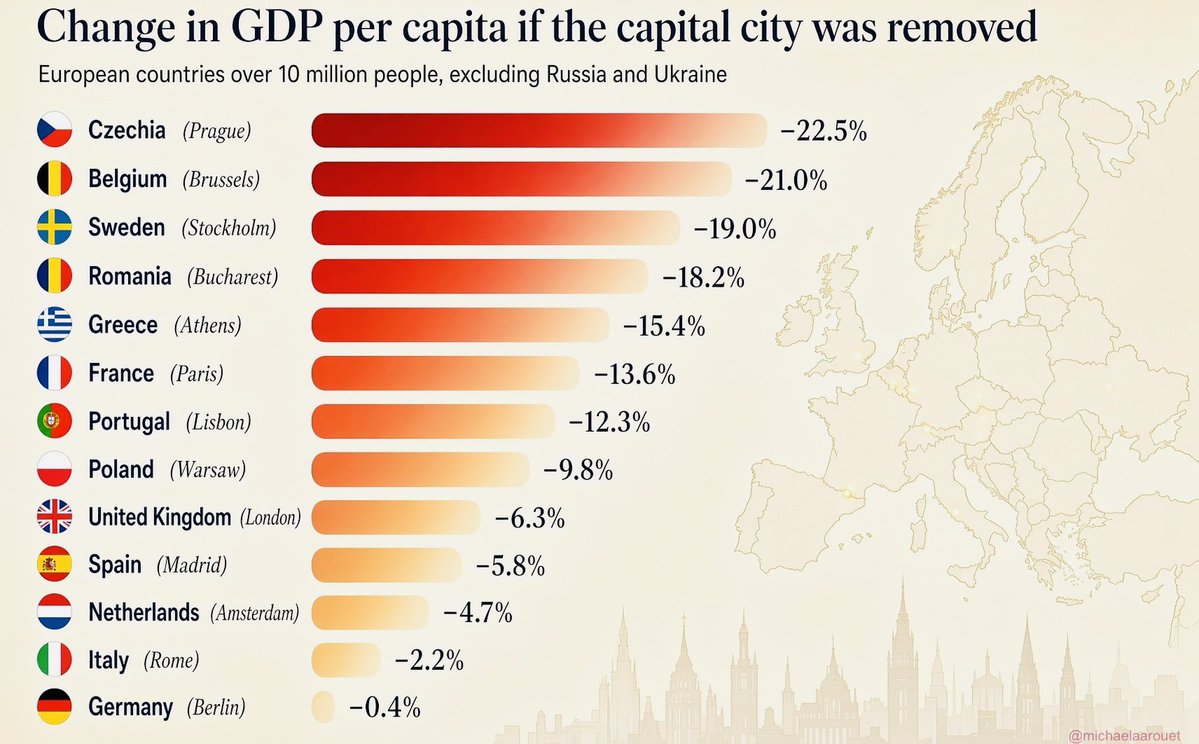
Remove the Capital and Most of Europe Gets 20% Poorer. Germany Loses 0.4%
Take the capital city out of the national accounts and Czechia's GDP per capita falls 22.5%, Belgium's 21.0%, Sweden's 19.0% and France's 13.6%. Germany's falls 0.4%.
■ Germany's money is not in Berlin
Berlin's GDP per capita was about €56,700 in 2024 against a national average of roughly €54,200. The two numbers sit almost on top of each other, so removing Berlin barely moves the national figure. Germany's richest places are Hamburg and Upper Bavaria, home to Munich, where GDP per capita reached €75,400 in 2024. Four decades of division pushed headquarters and factories to Munich, Frankfurt, Hamburg and Düsseldorf, and reunification never brought them back.
The ranking also has a trap in it. GDP is counted where people work, population where people live. About 360,000 people commute into Brussels each day from Flanders and Wallonia. Their output lands in the Brussels figure while they do not, which is what makes the city look so rich. Measured by disposable income per head, Brussels actually sits below Flanders, and 30% of its residents live in poverty.
Source: German Federal Statistical Office, National Bank of Belgium and the OECD (Image: @MichaelAArouet)