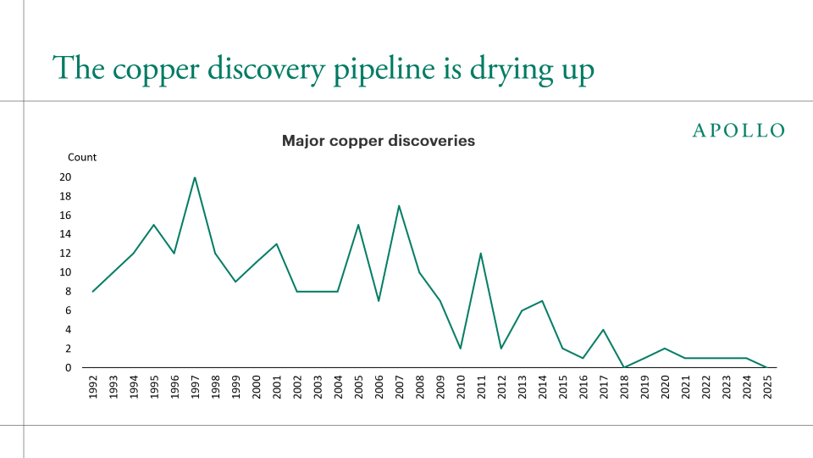
Not a Single Major Copper Deposit Was Discovered in 2025
In 2025, the world did not discover a single major copper deposit.
S&P Global counts a deposit as a major discovery if it holds at least 500,000 tonnes of copper. In the 1990s and 2000s there were often more than ten a year, with a peak of 20 in 1997. Since 2019 the count has dropped to one or two a year, and in 2025 it was zero.
Fewer discoveries are only the first half of the problem. S&P Global finds it takes an average of 17.5 years to go from discovery to production, and of the 263 major discoveries made since 1990, 165 are still not producing. Exploration, permits, financing and construction all form a queue, so miners put their money first into expanding existing mines. Most of the copper added in the latest count also came from expanding known deposits.
That means copper supply over the next decade and more is largely set by today's mines and the projects already in line. Demand from data centres and power grids can appear within two or three years, while supply needs more than a decade to respond, leaving price as the main thing that balances the two.
The most recent years may be revised up later. A deposit only enters the count once its resource estimate is complete, so recent discoveries are often added a few years late. Zero may not be the final number, but the downward trend is clear.
Source: S&P Global, Apollo (Image: @minenergybiz)