【2025年全球沒有發現任何一座大型銅礦 ⛏️】
2025年,全球沒有發現任何一座大型銅礦。
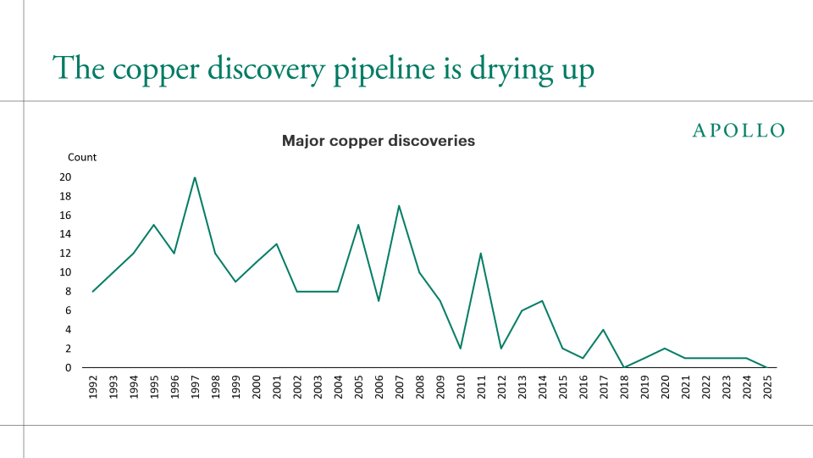
標普全球把含銅量至少50萬噸的礦床算作大型發現。1990年代到2000年代,每年常有十座以上,1997年多達20座;2019年以後每年只剩一、兩座,2025年是零。
發現得少只是前半段問題。標普全球統計,從發現礦床到開始出礦平均要17.5年;1990年以來的263座大型發現裡,至今還有165座沒有投產。探勘、審批、籌資和建設都在排隊,礦業公司因此把錢優先花在擴建既有礦場,最新一次統計新增的銅量,也多半來自舊礦床擴充。
這代表未來十幾年的銅供給,大致已經由現有礦場和排隊中的案子決定。資料中心和電網的用銅需求可以在兩、三年內冒出來,供給端卻要花十幾年才能回應,價格就成了調節兩邊的主要工具。
但最近幾年的數字之後可能上修。一座礦要等資源量估算完成才會被列入統計,近年的發現常常晚幾年才補進來,所以零不一定是最終答案,趨勢向下則很明確。
資料來源:標普全球、Apollo(圖片來自 @minenergybiz)
Not a Single Major Copper Deposit Was Discovered in 2025
In 2025, the world did not discover a single major copper deposit.
S&P Global counts a deposit as a major discovery if it holds at least 500,000 tonnes of copper. In the 1990s and 2000s there were often more than ten a year, with a peak of 20 in 1997. Since 2019 the count has dropped to one or two a year, and in 2025 it was zero.
Fewer discoveries are only the first half of the problem. S&P Global finds it takes an average of 17.5 years to go from discovery to production, and of the 263 major discoveries made since 1990, 165 are still not producing. Exploration, permits, financing and construction all form a queue, so miners put their money first into expanding existing mines. Most of the copper added in the latest count also came from expanding known deposits.
That means copper supply over the next decade and more is largely set by today's mines and the projects already in line. Demand from data centres and power grids can appear within two or three years, while supply needs more than a decade to respond, leaving price as the main thing that balances the two.
The most recent years may be revised up later. A deposit only enters the count once its resource estimate is complete, so recent discoveries are often added a few years late. Zero may not be the final number, but the downward trend is clear.
Source: S&P Global, Apollo (Image: @minenergybiz)