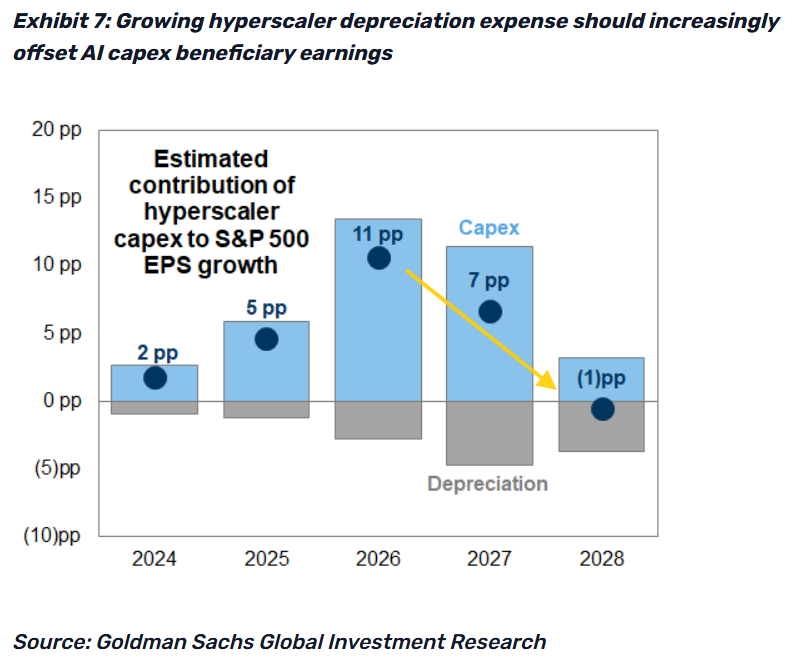
AI Spending Adds 11 Points to S&P 500 Earnings Growth This Year, Then Turns Into a Drag by 2028
The AI capital spending of the big cloud companies is revenue for someone else and a cost for themselves. The two sides just hit the books at different times.
Goldman Sachs estimates that cloud capital spending adds about 11 percentage points to S&P 500 earnings-per-share growth this year. In 2027, depreciation starts eating about 5 points of that, leaving a net boost of 7. By 2028 the net effect turns to minus 1 point.
The reason is accounting. When a cloud company buys a server, the money becomes revenue and profit for suppliers such as Nvidia and Broadcom in the same year. For the buyer, though, the purchase is not an expense that year. It is depreciated gradually over five to six years. As spending grows year after year, depreciation piles up layer by layer, and once capex growth slows, the new profit going to suppliers each year can no longer keep up with accumulated depreciation.
Goldman expects capex to rise to $1.2 trillion in 2027 and $1.4 trillion in 2028. Spending is still growing, but slower growth alone is enough to push the net effect to zero.
This only counts the accounting flows in and out. It leaves out new revenue from AI services themselves. If cloud companies earn money from AI fast enough, depreciation will not become a net drag, and that is what matters most in earnings reports over the next two years.
Source: Goldman Sachs Global Investment Research, Benzinga (Image: @neilsethinew)