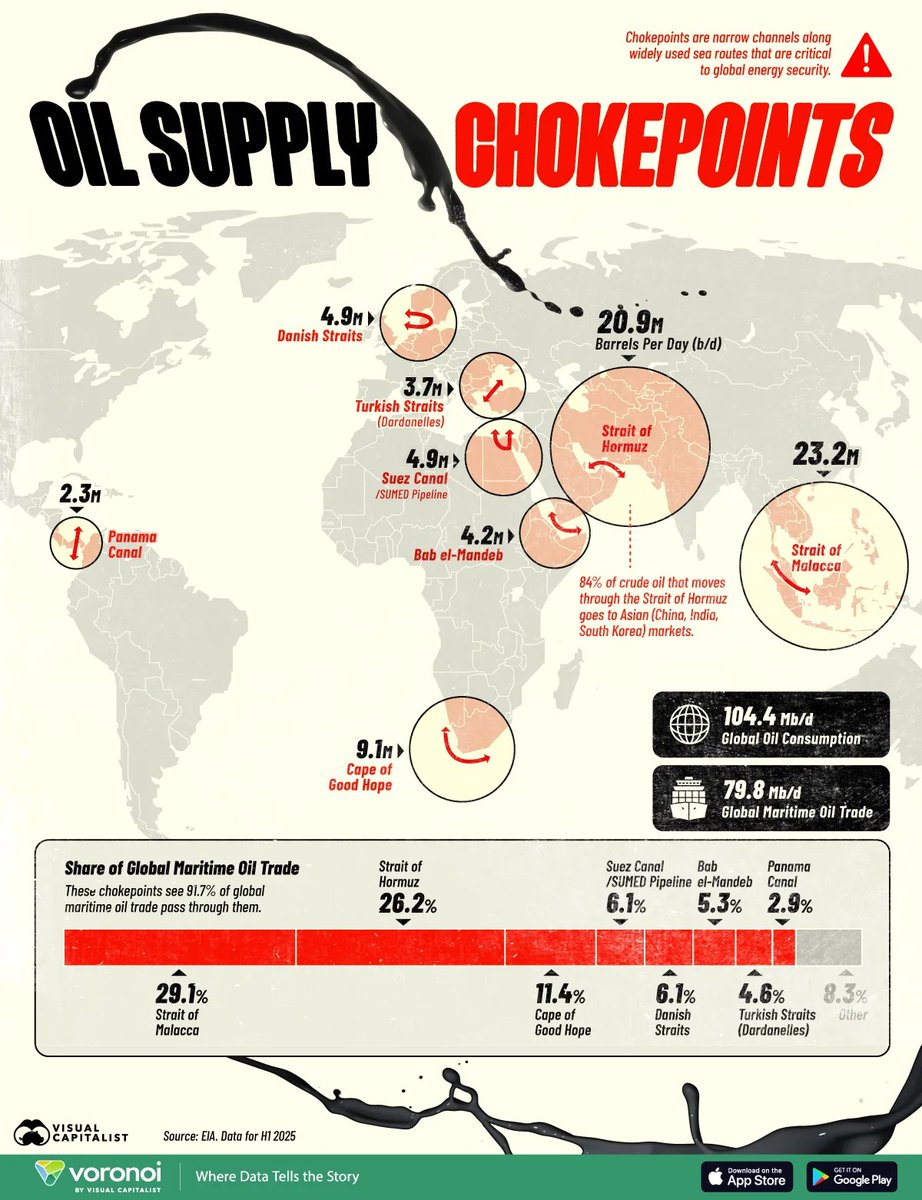
Hormuz Stalled, and Untouched Malacca Lost Nearly 30% of Its Oil
The Strait of Malacca was never blockaded, yet the oil flowing through it fell by nearly 30%.
According to the US Energy Information Administration, about 23.2 million barrels of oil a day passed through Malacca in the first half of 2025, making it the world's largest maritime chokepoint. The Strait of Hormuz came second at 20.9 million barrels. Add up the shares of all seven chokepoints and they equal 91.7% of global seaborne oil trade.
Those two numbers overlap heavily. Oil heading from the Persian Gulf to China, Japan and South Korea leaves through Hormuz and then passes through Malacca, so the same barrel is counted once at each strait. Some 84% of the crude moving through Hormuz goes to Asia, which means a big share of Malacca's traffic is simply Hormuz's downstream.
Once the war began, that link became obvious. The EIA estimates Hormuz carried only 4.9 million barrels a day in the second quarter of this year, and Malacca fell with it to 16.6 million. Saudi Arabia shifted exports to its Red Sea coast, and flows heading south through the Bab el-Mandeb rose from 4.2 million to 8.1 million barrels.
So judging chokepoint risk means looking at where the oil comes from, not just how much passes one strait. For Asian buyers, the real single point of failure is Hormuz, and most of Malacca's flow is an extension of it.
Source: US Energy Information Administration, Visual Capitalist (Image: @glocalinvestor)