Daily · 2026-09-23
Yesterday we wrote that when Meta's AI agent Muse went viral, the market first bought CPU makers. On Tuesday, September 22, attention turned to the other side: which businesses could lose out to agents. The S&P 500 finished flat and the Nasdaq Composite rose 0.45% to another record, but the Financial Select Sector SPDR ETF (XLF) fell 1.97%. Brokers fell the most. LPL Financial (LPLA), which supports more than 32,000 financial advisors, dropped 7.45%, and Charles Schwab (SCHW), which holds about $13 trillion in client assets, dropped 6.11%.
In a Schwab brokerage account, cash that has not been invested earns 0.01% a year. A Schwab money market fund with no minimum investment, available in the same account, has a 7-day yield of 3.62%. On $100,000 held for a year, that is about $10 of interest versus about $3,620. The interest clients forgo is where Schwab's spread comes from.
The market sold income that depends on clients not moving their cash.The spread exists not because clients have no choice, but because they do not make one, and making that choice is exactly what AI agents are built to take over. For now, though, Muse can only check out purchases for its users, each one needs the user's approval, and it cannot move money between accounts. Tuesday's prices reflect that risk, not deposits that have already left.
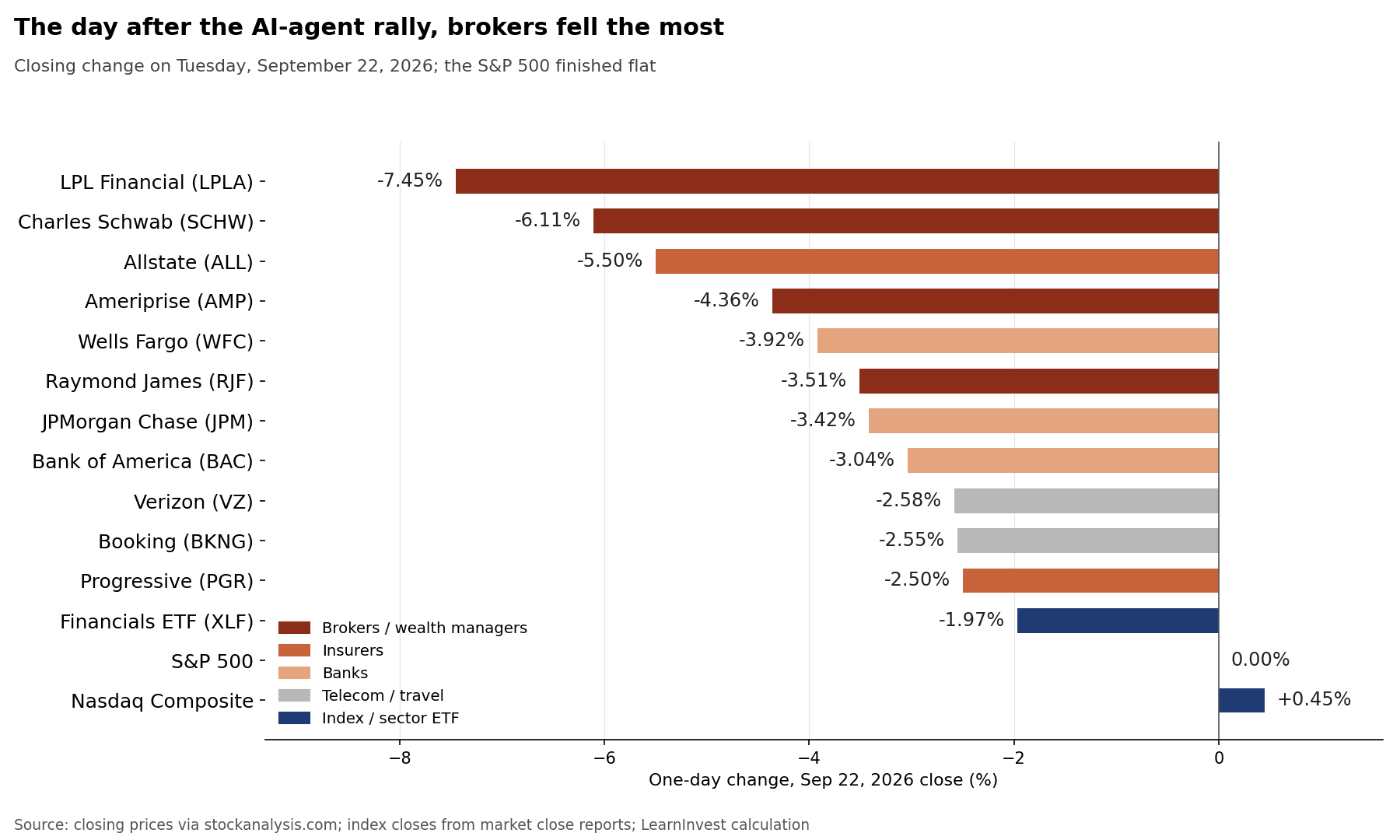
Chart 1 | On September 22 the S&P 500 finished flat, LPL and Schwab fell the most, and four large banks fell between 1.9% and 3.9%. (LearnInvest chart, based on September 22 closing prices)
Brokers fell the most, not banks
Among financial stocks, Tuesday's losses came in a clear order:
・Brokers and wealth managersLPL down 7.45%, Schwab 6.11%, Ameriprise (AMP) 4.36%, Raymond James (RJF) 3.51%
・Large banksWells Fargo down 3.92%, JPMorgan Chase 3.42%, Bank of America 3.04%, Citigroup 1.91%
The selling was not limited to financial stocks. On the same day, insurers Allstate and Progressive fell 5.50% and 2.50%, telecom company Verizon fell 2.58%, and travel booking platform Booking fell 2.55%. According to Investing.com, Goldman Sachs' trading desk warned that day that industries relying on recurring bills, add-on services and customer passivity were most exposed. What these businesses share is customers who rarely compare prices or switch providers. The scenario the market fears is agents that compare prices for their users, cancel memberships nobody uses, switch insurance policies when premiums are cheaper elsewhere, and move idle cash to where it earns more.
Overall, brokers fell more than banks because that last item goes straight to the source of their profits.
Schwab's spread depends on clients not choosing
Schwab's total net revenue in the second quarter was $7.07 billion. Net interest revenue was $3.36 billion, or 47%. Adding $333 million in bank deposit account fees, earned on client cash placed at partner banks, about 52% came from the spread. Schwab's quarterly filing puts it plainly: the company earns net interest revenue by investing client cash and deposits in interest-earning assets.
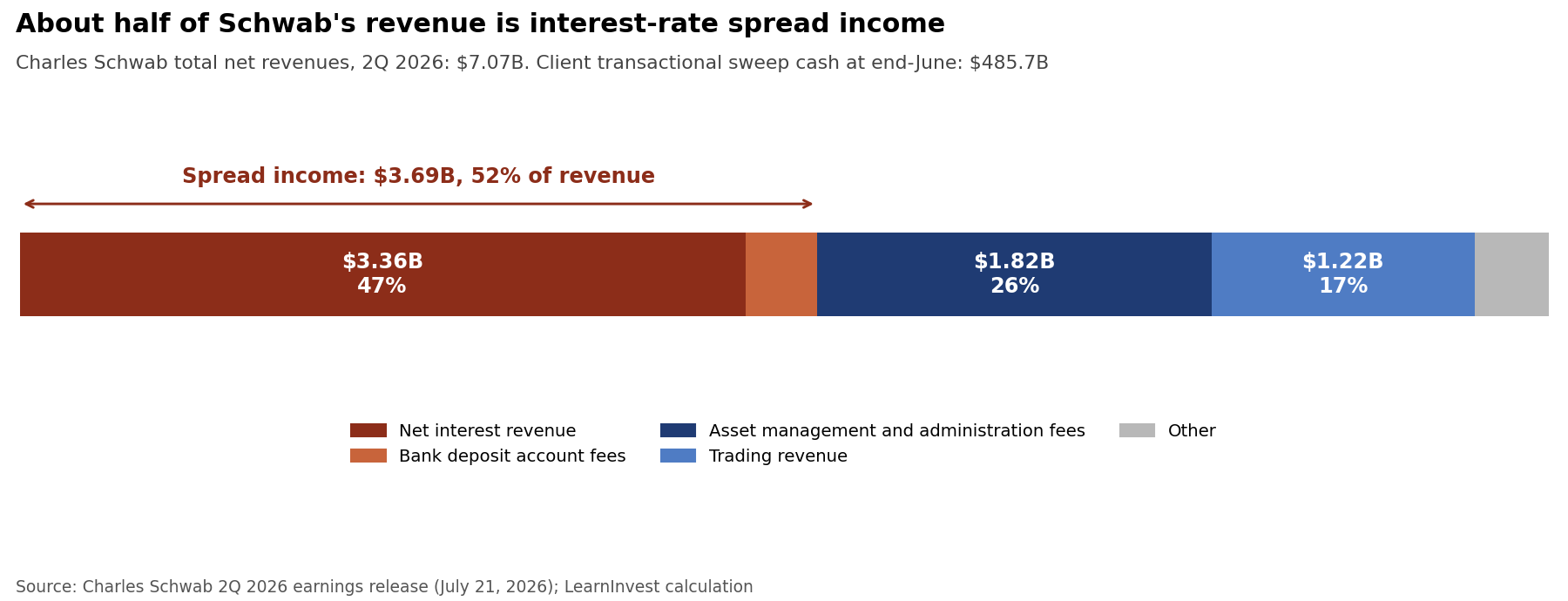
Chart 2 | About 52% of Schwab's second-quarter revenue came from net interest revenue and bank deposit account fees; client sweep cash stood at $485.7 billion at the end of June. (LearnInvest chart, based on Schwab's second-quarter 2026 results)
The raw material for this business is sweep cash, the uninvested money in client accounts that is automatically moved into bank deposits. It stood at $485.7 billion at the end of June. Part of it is working cash for trading that was never going to move. But in the second quarter, with the Fed's policy rate still at 3.50% to 3.75%, money market funds paid far more than sweep cash, and clients could switch with a few clicks in the same account. Schwab's sweep cash still rose by $24.2 billion from the previous quarter.
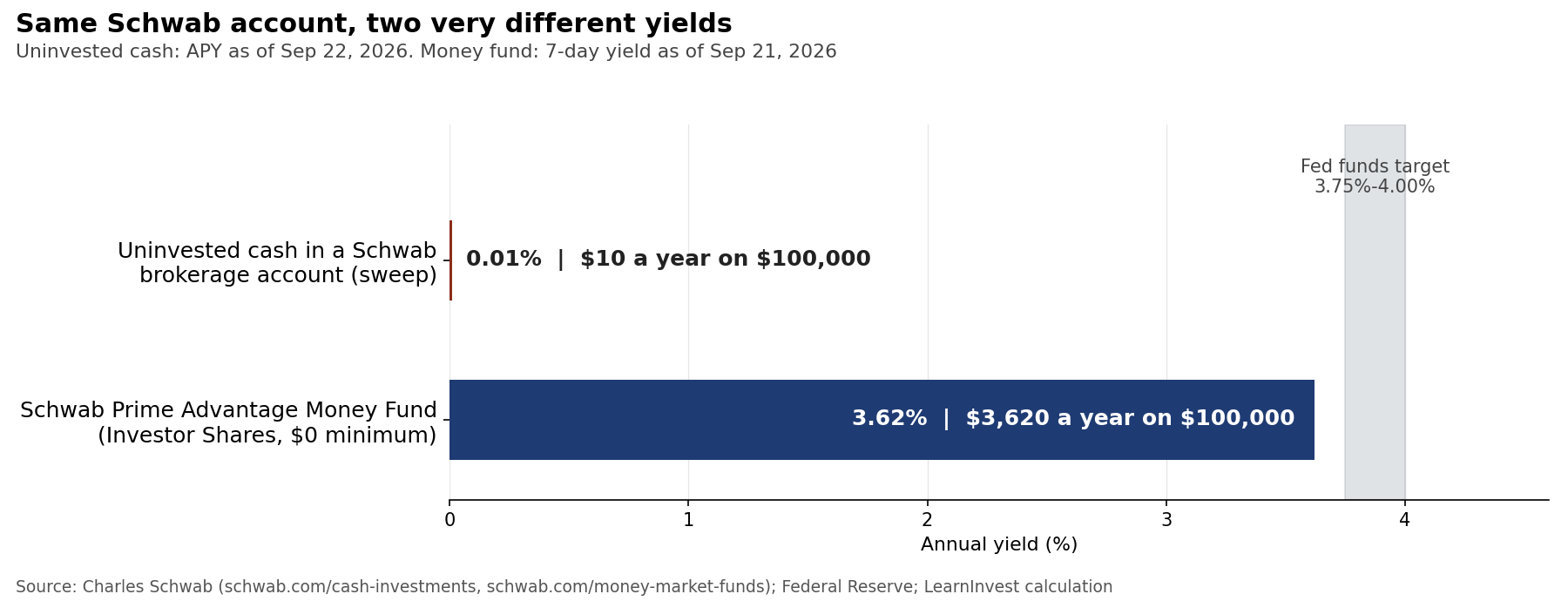
Chart 3 | In the same Schwab account, uninvested cash earns 0.01% a year while a Schwab money market fund with no minimum investment yields 3.62%, a gap of about $3,610 a year on $100,000. (LearnInvest chart, based on rates posted on Schwab's website on September 21 and 22)
If an agent optimizes a client's allocation around the clock, how much of the cash sitting in the system will be left? Brokers have never had to answer that question, because few clients are willing to compare rates for themselves every day.
Muse cannot move money yet
For now, Muse's only money-related feature is checkout. It launched on September 8 with Stripe's Link payments, and PayPal was added on Tuesday. For every purchase, the user has to confirm the total in the chat, and Muse never sees the payment details. No public information shows that it can move money between bank and brokerage accounts or switch an insurance policy for someone. As we noted yesterday, Amazon has already blocked Muse from placing orders on its site.
Not all of Tuesday's selling came from Muse:
・RatesThe Fed raised rates by a quarter point on September 16, lifting the target range for the federal funds rate to 3.75% to 4.00%. The higher rates go, the stronger the pull to move idle cash into money market funds, and that is happening without any agent: US households' money market fund holdings have risen to a record $5.11 trillion
・BanksAccording to Reuters, the gap between 2-year and 10-year Treasury yields narrowed to its smallest since March 2025, squeezing banks' lending spreads
・InsurersAllstate reported only on September 17 that its August catastrophe losses were $748 million
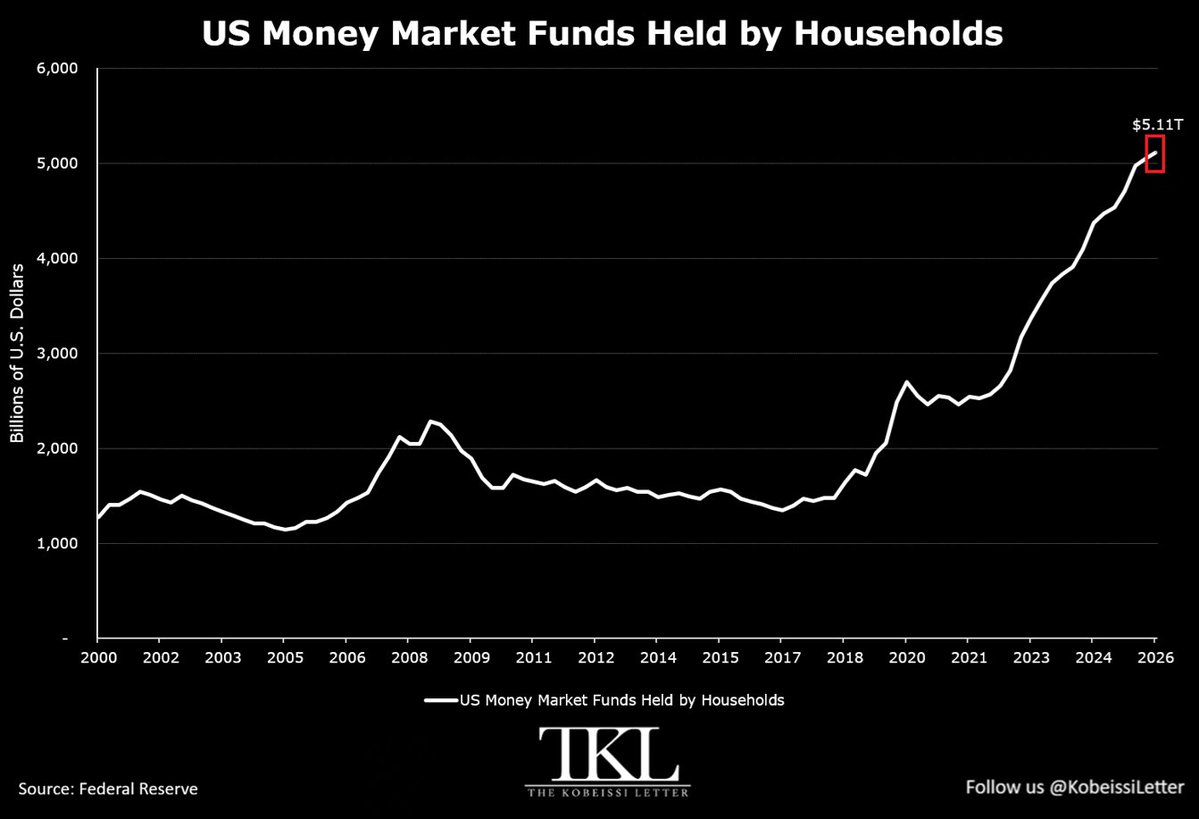
Chart 4 | Money market fund holdings of US households rose to a record $5.11 trillion. (The Kobeissi Letter, based on Federal Reserve data)
A similar drop in February, and the stock took months to recover
This has happened before. On February 10, the wealth platform Altruist launched an AI tax planning tool, and wealth management stocks lost about $20 billion in market value in a single day, Schwab among them. Schwab's earnings kept setting records after that, and it brought in $120 billion of core net new assets in the second quarter, so clients did not leave. Even so, on June 12 the stock was still about 15% below its 52-week high.
The industry is also preparing to run this business itself. Schwab CEO Rick Wurster said on an April earnings call that if clients want the firm to move their cash proactively without being involved, that is likely an advisory offer, that Schwab charges for advisory offers, and that it would charge for an agent doing it too. On September 14, Schwab became the first RIA custodian (a firm that holds client assets for independent investment advisers) connected to Anthropic's Claude for Financial Advisors, letting advisers use Claude to read their clients' balances, positions and transaction history at Schwab. Agents could move money out for clients, and they could also become a new service brokers charge clients for.
What to watch next: Schwab's sweep cash
Tuesday's drop was the market recalculating the risk to income that depends on clients not making a choice.For that risk to materialize, two things have to happen together: agents gaining permission to move money between accounts, and users being willing to let them do it. The first has not happened yet, and on the second, Muse still needs approval for every purchase.
Schwab publishes its operating data for the previous month in the middle of each month, including sweep cash balances. If agents really start moving money, it will show up in this number first. The September figures due in mid-October will be the first to cover the period since Muse launched.
Sources: Charles Schwab second-quarter 2026 results and Form 10-Q; Charles Schwab cash investments and money market fund rate pages (September 21-22, 2026); LPL Financial second-quarter 2026 results; Federal Reserve; Meta; Stripe; PYMNTS; TechCrunch; Investing.com; Reuters; The Insurer; RIABiz; WealthManagement.com; TIKR; US market closing data. Images: LearnInvest charts; @KobeissiLetter.