Daily · 2026-09-22
Muse, the personal AI agent Meta launched on September 8, was the most downloaded free iPhone app in the US for three days running. At Monday's close (September 21), Meta rose 11.43%, but the bigger gains went to companies that make CPUs (central processing units): Arm (ARM), which designs the chip architecture used in phones and servers, rose 17.16%, Intel rose 12.14%, and AMD rose 9.95%, closing above $1 trillion in market value for the first time. On the same day, Nvidia, the leader in AI chips, rose only 2.30%, barely more than the Nasdaq Composite's 2.26%.
What the market bought was a specific line of reasoning. A chatbot answers questions, and that work mostly runs on GPUs running the model. An AI agent sends emails, books trips and fills out forms for its user, and Meta gives every Muse its own dedicated computer in the cloud. Opening web pages, running code and calling other services mostly fall on the CPU.The more agents are used, the more CPUs are needed, and that is why money bypassed Nvidia on Monday and went into CPU makers.
Muse did not create this demand. Intel's Data Center and AI revenue was already up 59% year over year in the second quarter, and last week its CEO said the company can supply only about half of what customers want. Meta started working with Arm on a data center CPU back in March. What Muse did was bring a demand that had been sitting inside the supply chain onto ordinary people's phones for the first time. Muse itself has not yet shown it can make money, though: its revenue in the first 11 days was only about $27,000, and the stocks are running ahead of the orders.
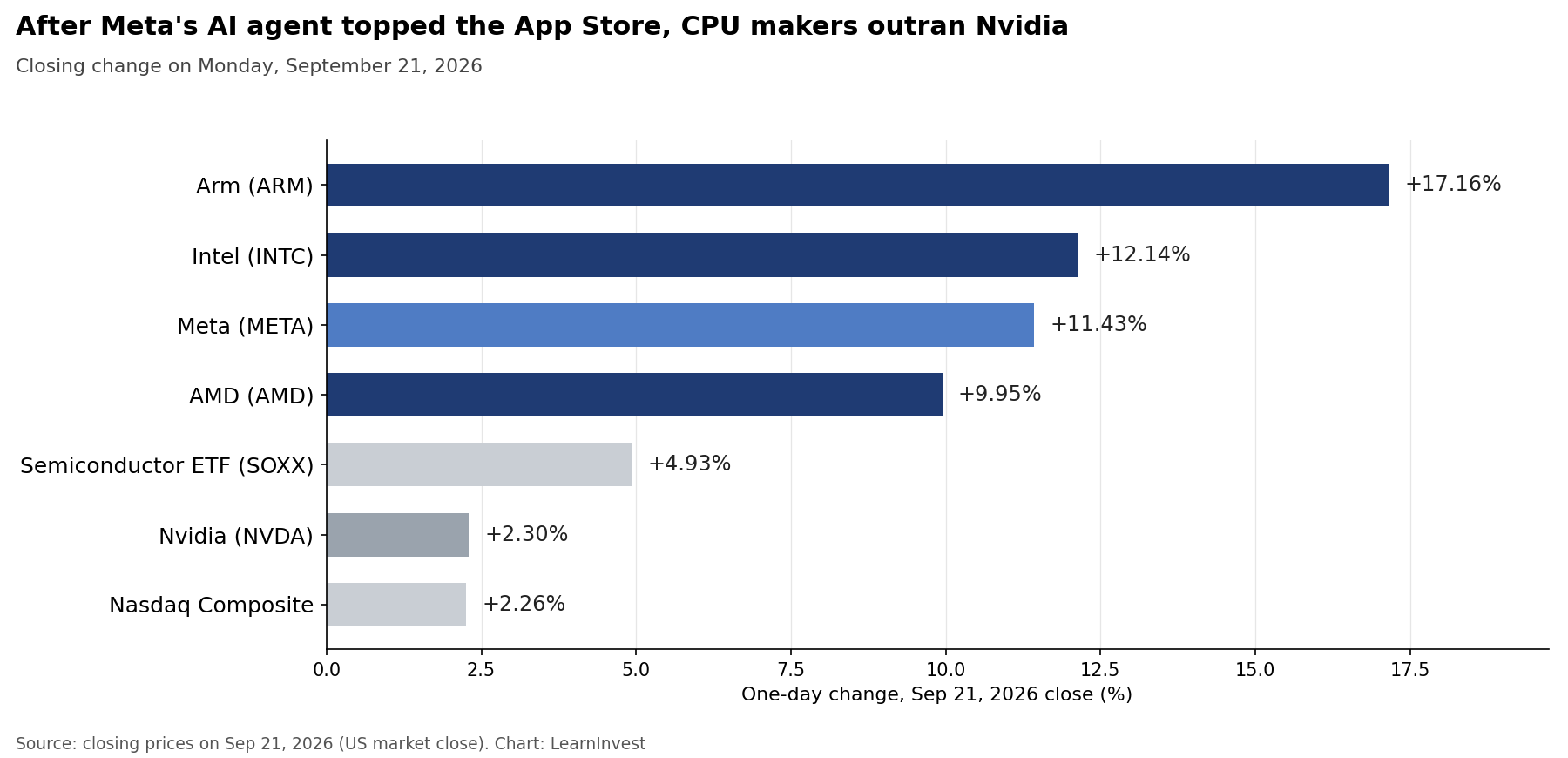
Chart 1 | After Muse topped the US App Store, Arm, Intel and AMD gained far more than Nvidia and the semiconductor ETF on September 21. (LearnInvest chart, based on September 21 closing prices)
The difference between a chatbot and an agent is a computer of its own
A chatbot answers one question at a time, while an agent keeps working on the user's behalf, and that difference makes the CPU matter again.In its September 8 announcement, Meta described Muse as something that "doesn't just answer questions, it actually does the work": it sends emails, books travel, fills out forms, and keeps working after the app is closed. Every Muse runs on its own dedicated, isolated computer in the cloud.
The work splits into two parts:
・Understanding the request and writing the replythis is model computation, handled mainly by GPUs
・Carrying out the taskopening web pages, reading and writing files, calling other services and running code in an isolated environment, handled mainly by CPUs
Nvidia lists exactly this second part as the job of its own Vera CPU: agent orchestration, data processing, tool use and sandboxed code execution.
The volume of agent work is already growing fast. According to OpenRouter, a platform that routes requests across AI models, tokens used by agents on the platform (7-day average) were:
・February 6about 0.51 trillion, passing human usage of about 0.5 trillion for the first time
・August 10about 7.3 trillion, roughly 14 times higher in six months; human usage grew about 2.8 times over the same period, to about 1.4 trillion
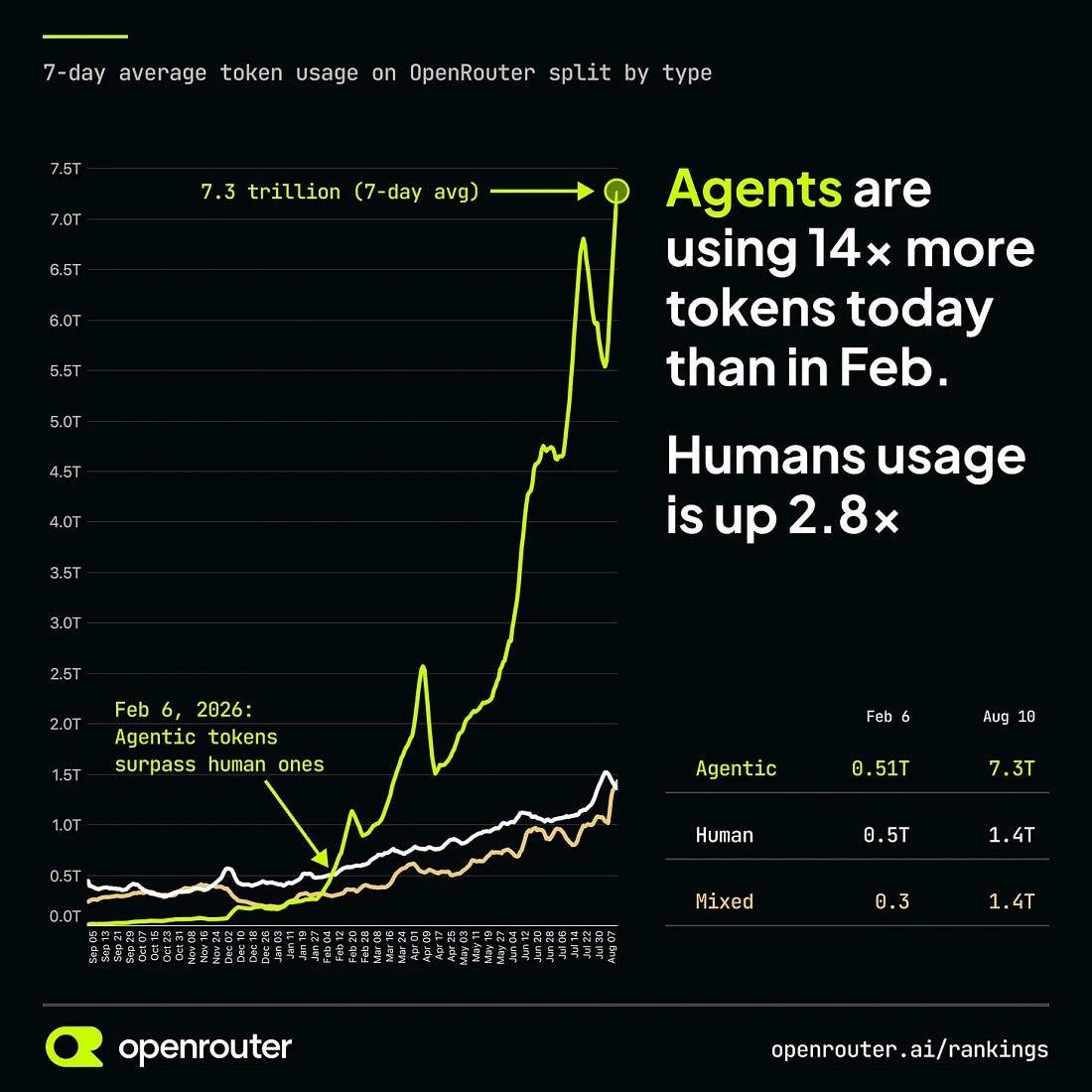
Chart 2 | Tokens used by agents on OpenRouter rose from about 0.51 trillion in February to about 7.3 trillion in August, while human usage grew about 2.8 times. (OpenRouter)
In the CPU market, Citi's forecast shows how much weight agents carry. The server CPU market was about $29 billion in 2025, and Citi expects about $237 billion in 2030, roughly eight times larger. Most of the increase comes from agents: agentic applications rise from about 1% of the server CPU market in 2025 (about $0.3 billion) to about 52% in 2030 (about $123 billion), while general-purpose CPUs fall from 71% to 22%.
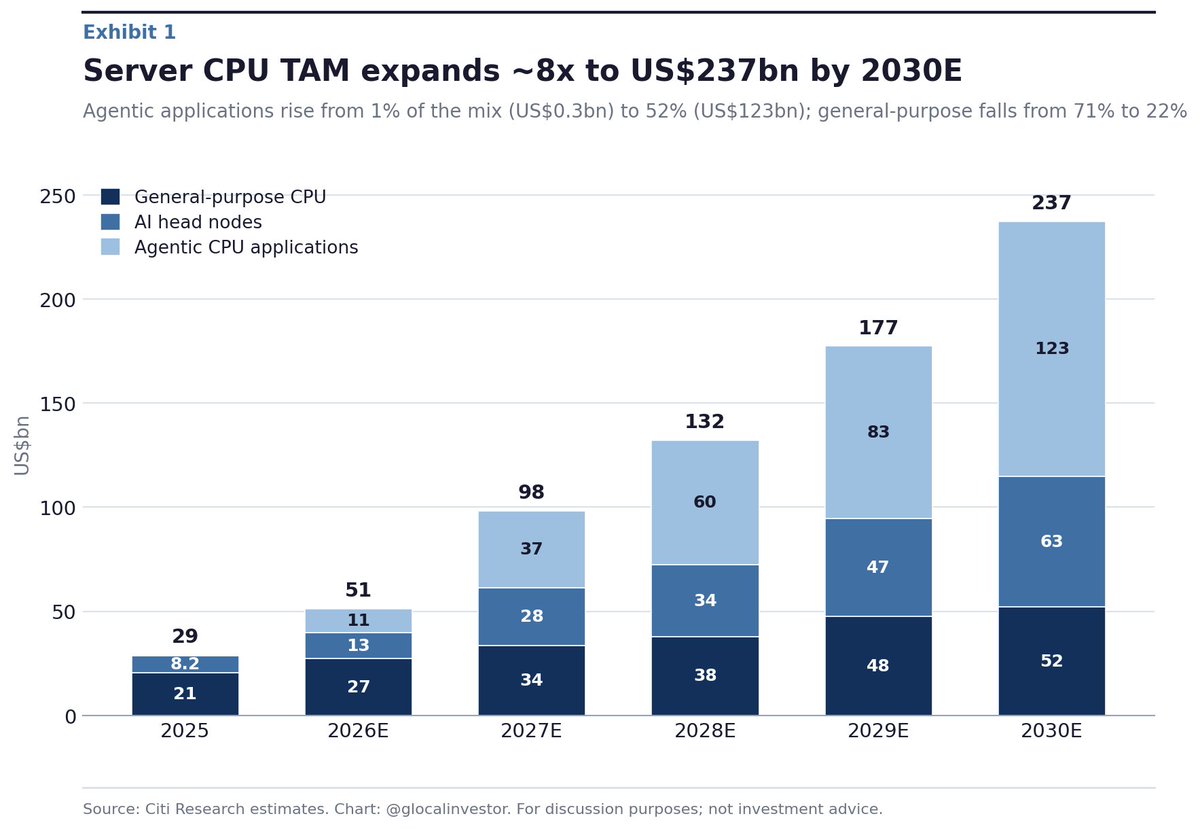
Chart 3 | Citi expects the server CPU market to reach about $237 billion in 2030, with agentic applications at about $123 billion, more than half. (Citi Research)
Put another way, nearly 60% of the growth in Citi's server CPU forecast comes from agentic applications. A large part of the CPU makers' growth story rests on agents, and Muse reaching the top of the charts gave that assumption a visible example.
The CPU shortage started before Muse
Evidence that CPUs are in short supply was already in earnings reports and supply chain data before Muse launched.
・IntelSecond-quarter Data Center and AI revenue was $6.3 billion, up 59% year over year; non-GAAP gross margin (which excludes some one-time and non-cash items) was 41.8%, versus 29.7% a year earlier. According to The Motley Fool, CEO Lip-Bu Tan said at Splunk's annual conference last week that Intel is currently meeting only about half of what its customers are asking for.
・AMDSecond-quarter Data Center revenue was $6.7 billion, up 107% year over year, which the company attributed mainly to demand for EPYC server processors and Instinct accelerators.
・MetaOn March 24, Meta announced it would be lead partner and co-developer of the AGI CPU, Arm's first data center CPU, a chip aimed at large-scale AI and agentic AI deployments.
Prices are reflecting the shortage too. Bernstein, citing Mercury Research data, noted that in the second quarter Intel's share of server processor units fell by about 1.4 percentage points while its share of server revenue rose by about 1.7 points. Selling a smaller share of units while collecting a larger share of the money means Intel's prices are rising.
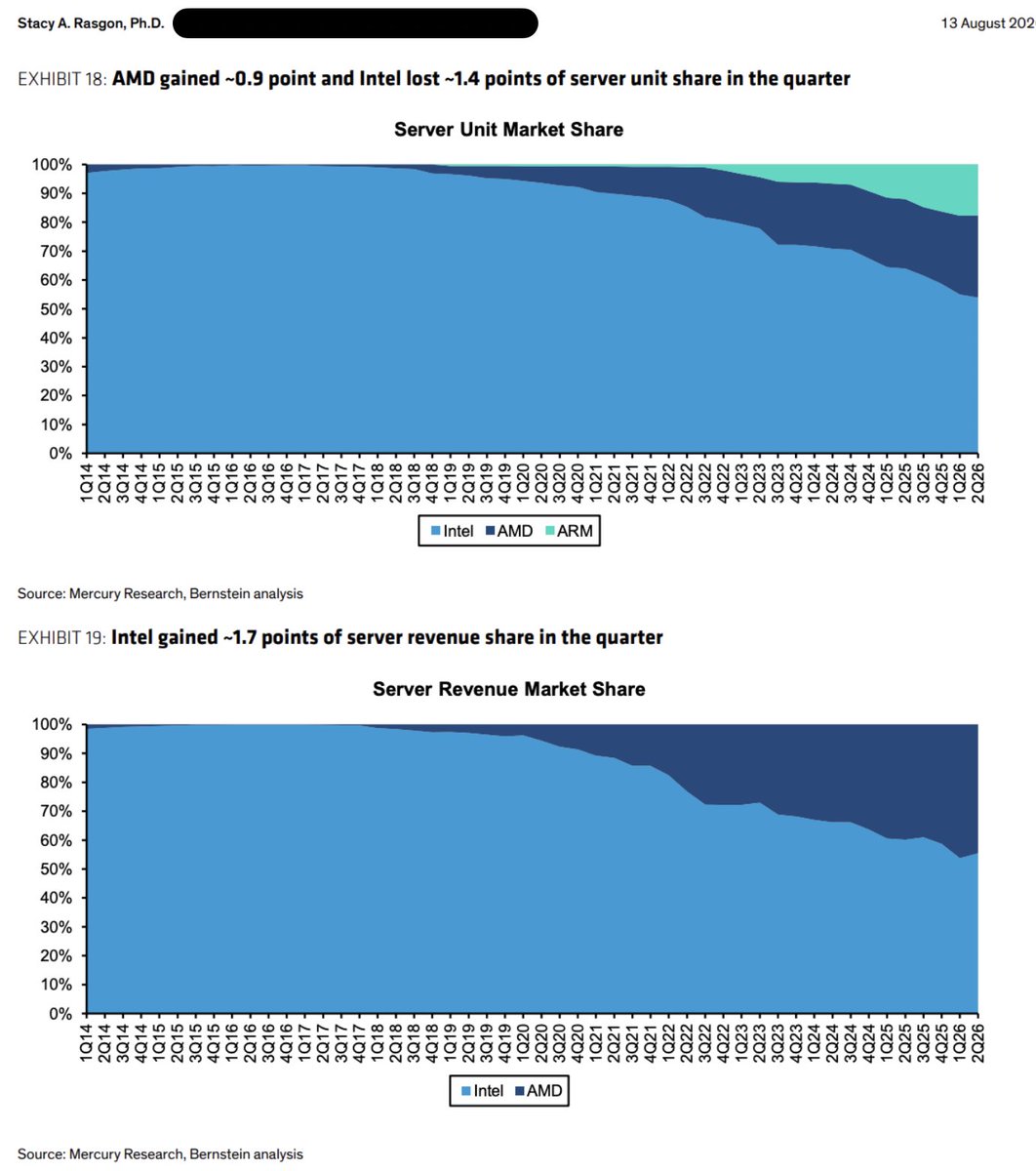
Chart 4 | In the second quarter, Intel's server processor unit share fell about 1.4 percentage points while its revenue share rose about 1.7 points. (Bernstein, data from Mercury Research)
The stocks were also moving well ahead. According to Evercore ISI, as of August 7, Intel, Arm and AMD had each more than doubled year to date, the Philadelphia Semiconductor Index was up 74%, the S&P 500 was up 13%, and Nvidia was only slightly ahead of the S&P 500. Monday's jump was a trend that had run for most of the year speeding up once more.
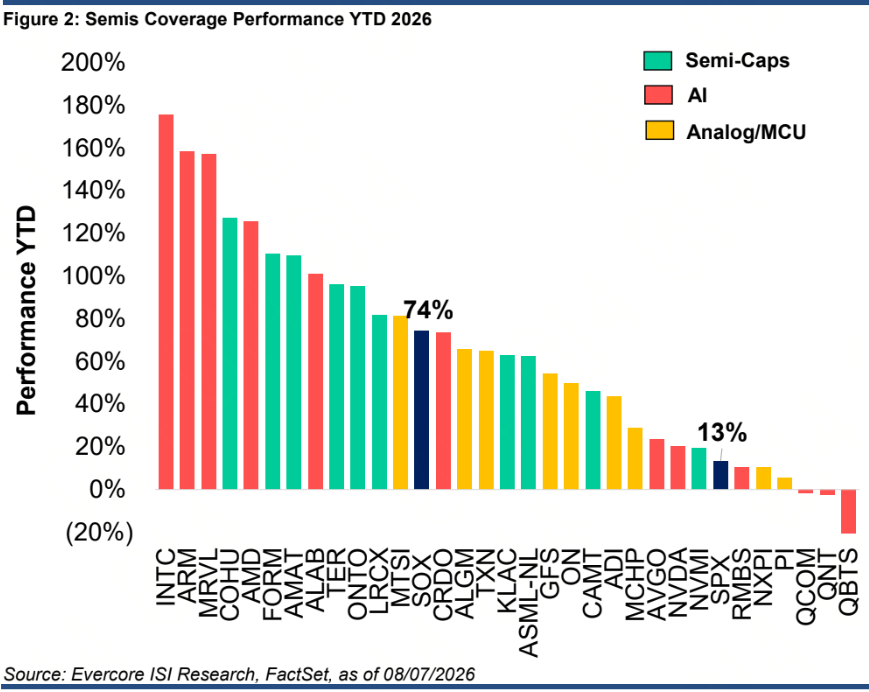
Chart 5 | As of August 7, Intel, Arm and AMD had each more than doubled this year, while the Philadelphia Semiconductor Index was up 74% and the S&P 500 was up 13%. (Evercore ISI, data from FactSet)
A bigger market, and more companies competing for it
A bigger CPU market does not mean every company gets the same share, and Nvidia is competing for it too.Nvidia's 2.30% gain on Monday does not mean it is shut out of this demand. According to 24/7 Wall St., Nvidia's Vera CPU is built on the Arm architecture with 88 custom cores, and it can be paired with Nvidia's own GPU platform or used on its own as a server processor. Nvidia management said it sees about $20 billion in server CPU demand and that CPU revenue could more than double in fiscal 2028.
Among CPU makers, market share is shifting as well. Citi's forecast for server CPU unit share:
・Intelfrom 62% in 2025 to 46% in 2030
・AMDfrom 24% to 37%
・Arm architecture and othersfrom 14% to 17%
The same forecast has total unit shipments growing about 21% a year, to about 76 million in 2030. At that pace, Intel would still ship more chips even as its share falls, and what is limiting it right now is capacity.
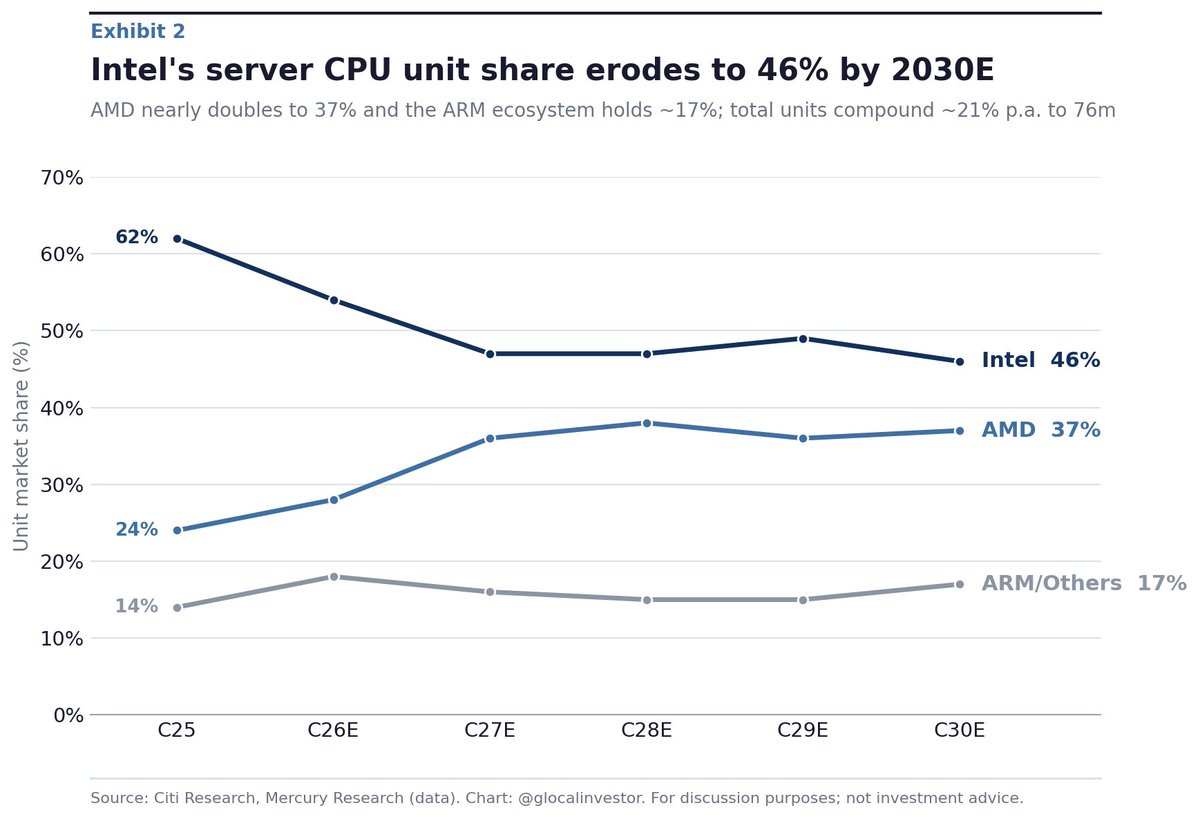
Chart 6 | Citi expects Intel's server CPU unit share to fall to 46% by 2030, AMD's to rise to 37%, and Arm architecture and others to hold about 17%. (Citi Research, data from Mercury Research)
The three companies also benefit in different ways. Arm has mainly licensed its chip architecture to other companies, and in March it announced it was developing its first data center CPU of its own with Meta. AMD is the one whose share keeps rising in Citi's forecast. Intel is the most direct beneficiary of the shortage, and how much it can sell is limited by its own capacity.
Muse itself has not yet shown it can make money
The direction of CPU demand is backed by supply-side evidence, but Muse as a business is still at a very early stage.
・RevenueAccording to app data firm Appfigures, Muse had been installed on about 1.1 million devices as of September 18, but its revenue after store fees in the first 11 days was about $27,000. Grok Bot, a similar agent app, made about $175,000 over the same length of time after launch.
・ShoppingLate on Sunday, September 20, Amazon began blocking Muse from placing orders on its site, saying Muse does not identify itself as an AI agent and can reach customers' account pages and purchase history. Meta said it will roll out a new isolation feature later this year so that Meta itself cannot read the data inside a user's Muse.
・Paid usersOppenheimer analyst Jason Helfstein estimated that for Meta to earn about $27.5 billion to $28 billion a year from Muse, it would need about 115 million subscribers paying $20 a month. He has doubts about paid conversion, competition from ChatGPT and Gemini, and whether users will trust Meta with their passwords.
Morgan Stanley's math is more conservative. Assuming Muse has 100 million monthly active users in 2028, it would bring in about $1.3 billion of revenue, adding only about 1% to Meta's earnings per share that year.
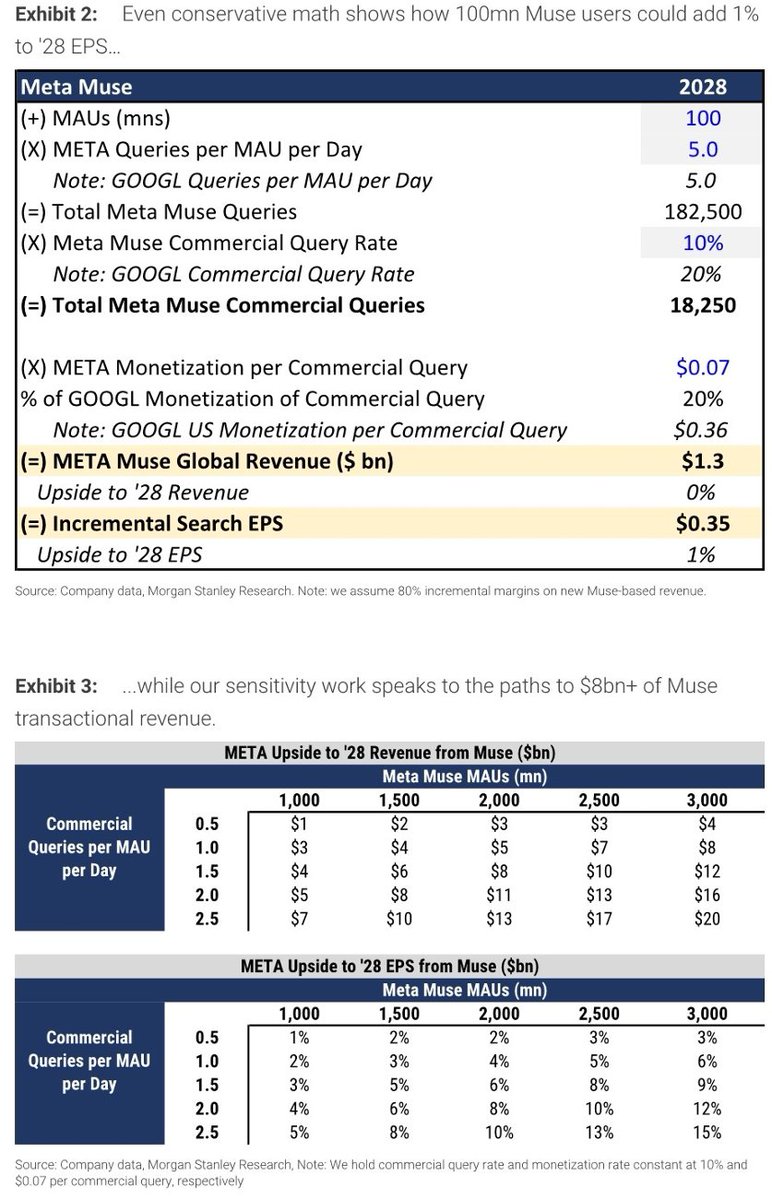
Chart 7 | Morgan Stanley assumes 100 million monthly active Muse users in 2028, bringing in about $1.3 billion of revenue and adding about 1% to Meta's earnings per share that year. (Morgan Stanley Research)
Based on a $1 trillion market value and a 9.95% gain, AMD alone added about $90 billion in market value on Monday, while the app behind the rally made less than $30,000 in its first 11 days. The market is willing to pay for that gap because Muse showed that ordinary consumers are willing to download and try an AI agent. How many orders those agents eventually bring the chipmakers will show up in the chipmakers' own earnings.
Next: chipmaker earnings and Muse retention
Monday's repricing can be split into two parts, and the first part is backed by evidence.The shortage, the price increases, the share shifts and the growth of the market were all in earnings reports and supply chain data before Muse, and they will not disappear if one app cools off. The second part is a bet that agents will enter the consumer market at scale, and for now the only support for it is download counts and chart rankings.
Two sets of numbers that are not out yet will decide the second part:
・Chipmakerswhether data center CPU revenue and gross margins keep rising in Intel's and AMD's next quarterly reports, and whether Intel's supply gap narrows
・Musewhether Meta discloses retention, completed tasks or paying users; until then, downloads only show that many people have tried it
Sources: Meta, "Introducing Muse" (September 8, 2026) and Arm data center CPU partnership announcement (March 24, 2026); Intel second-quarter 2026 results (July 23); AMD second-quarter 2026 results (August 4); OpenRouter; Appfigures; Sensor Tower; Citi Research; Bernstein; Mercury Research; Evercore ISI; FactSet; Morgan Stanley Research; Oppenheimer; The Motley Fool; 24/7 Wall St.; TechCrunch; SiliconANGLE; US market closing prices. Images: LearnInvest chart, @dailychartbook, @glocalinvestor, @jukan05, @Jadzo1_.