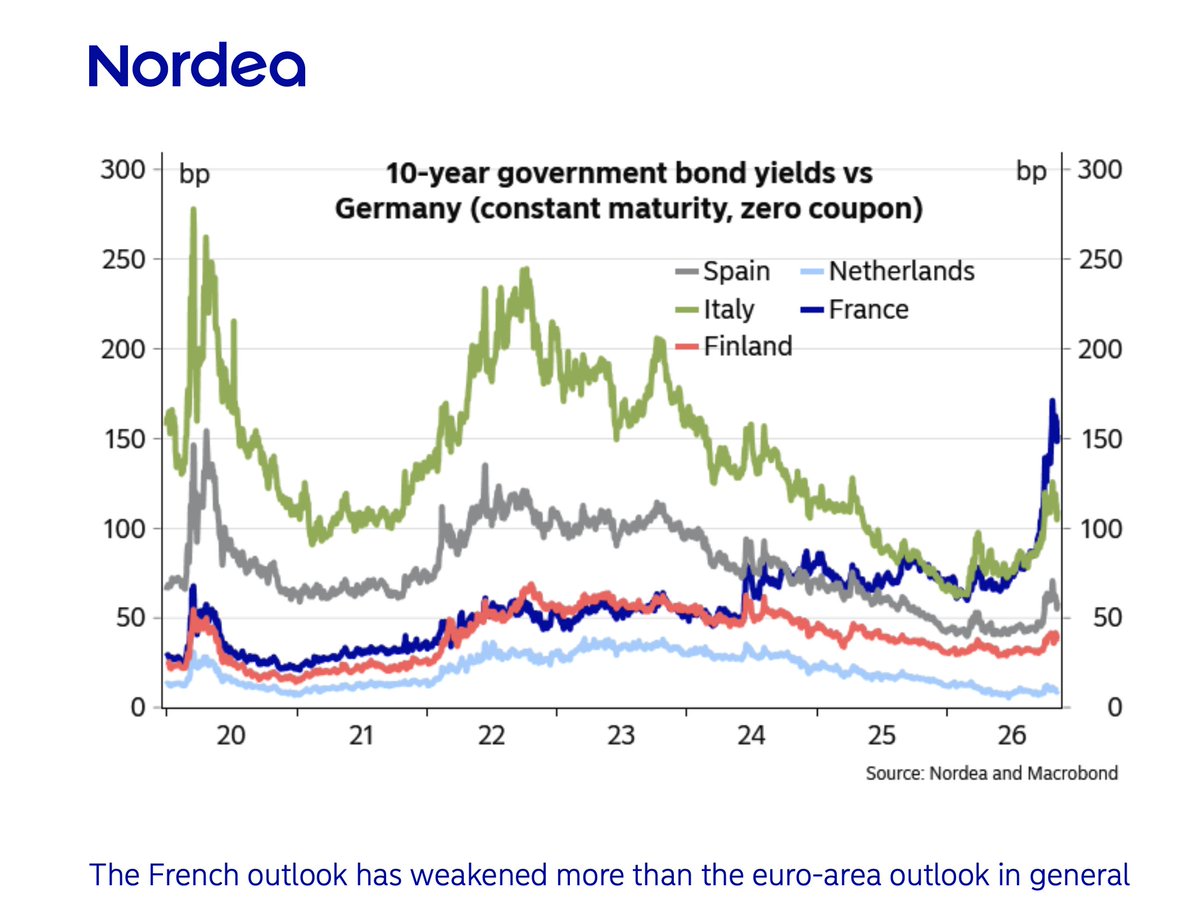
Markets Now Treat France as Riskier Than Italy
The gap between French and German ten year yields widened to about 170 basis points in late October, while Italy sat near 112 and Spain lower still. The euro area's most expensive large borrower has changed.
This ordering has not happened since the euro began. The spread between French and Italian ten year yields reached a record 30 basis points, and on one day in late October France yielded 4.93% against Italy's 4.56%. By early November the French spread over Germany had eased back toward 148 basis points, but the ranking held.
Debt ratios do not explain it. French government debt is around 121.7% of GDP, and Italy's is higher. What markets are pricing is direction rather than level. Italy's deficits have been narrowing and its budgets pass. France's deficit is widening, every budget is a test of whether the government survives, and a presidential election in 2027 sits ahead of it.
The other half of the story belongs to Italy. Its spread came down from 245 basis points in 2022 to 112, earned through several years of fiscal discipline. So this crossover is half French weakness and half Italian repair, and reading the French line alone turns it into a one way story.
For the European Central Bank this divergence is harder to handle than the level of rates. One policy rate is now reaching member states as visibly different borrowing costs.
Source: Nordea and Macrobond sovereign spread data, with major financial media reporting (Image: @acemaxx)