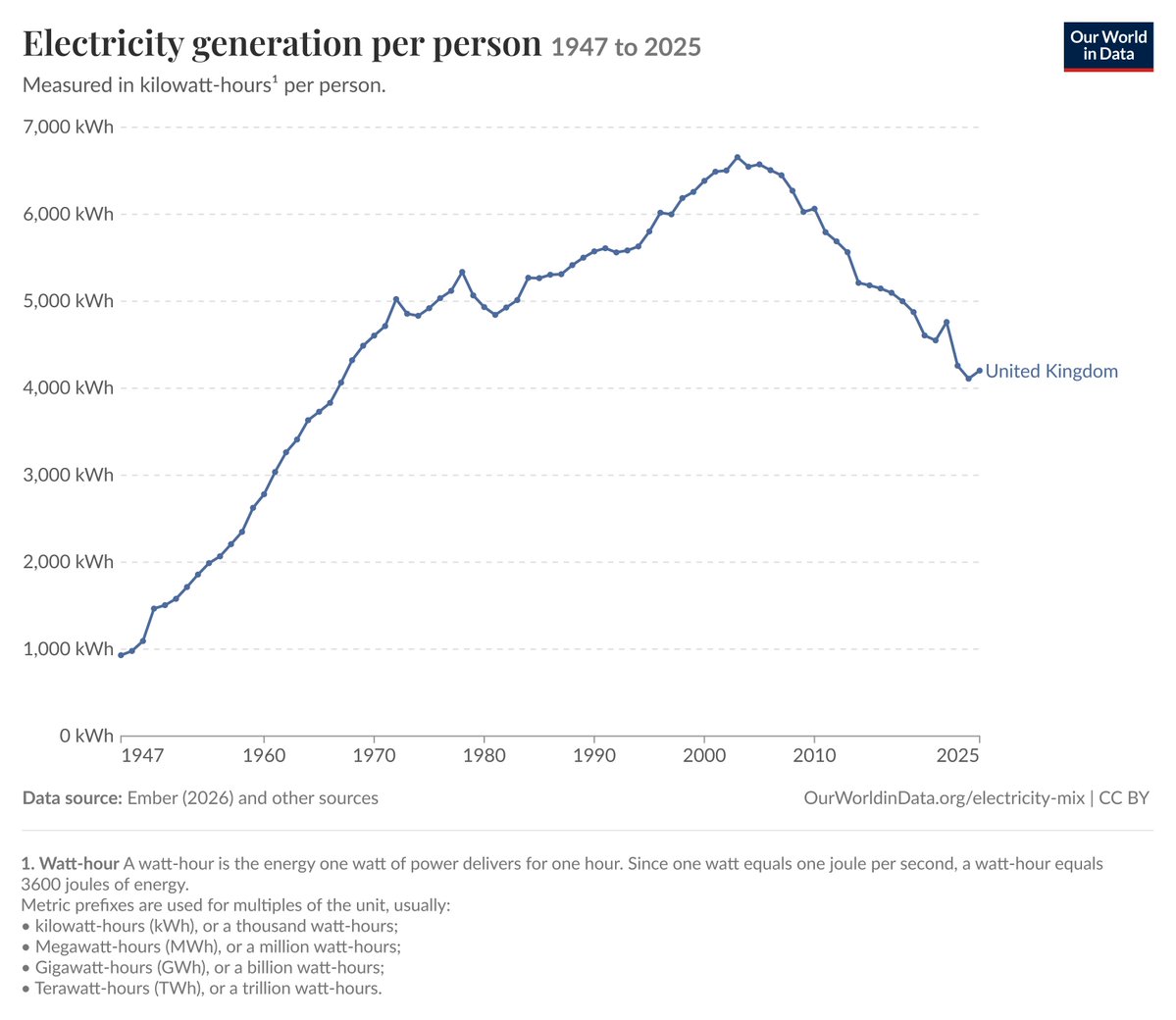
UK Electricity Per Person Is Back at 1970s Levels
The United Kingdom generated a little over four thousand kilowatt hours of electricity per person in 2025, less than it did in the 1970s. The peak around 2003 was above 6,700, and the fall since then is close to 40%.
Generation is not consumption, and that is the easiest way to misread this chart. Britain is a net importer of electricity. Net imports were 33.4 terawatt hours in 2024, and in 2025 the French interconnectors alone delivered a record 21.9 terawatt hours, with Norway at 9.0 and Belgium at 2.0. Over the past decade roughly 5% of annual supply has come from imports, and recent years have run higher. More electricity is used than this line shows.
Second, the line rose last year. Total UK generation increased 2.6% to 293.6 terawatt hours in 2025, driven by higher demand and higher exports. The long trend is down, but the final year is not.
The decline also has two causes that mean opposite things. One is efficiency. Lighting, appliances and insulation have cut a great deal of demand over twenty years, and that is a gain. The other is heavy industry leaving. When aluminium and steel production goes, its electricity demand goes with it, and so does the manufacturing output.
Treating those as one thing turns an efficiency gain and an industrial loss into the same number. The question worth asking is how that 40% splits between them.
Source: Ember and Our World in Data generation figures, with the UK Digest of Energy Statistics (Image: @puckrin)