AI Cut Drug Discovery to Nine Months, and Eight of Nine Are Still in Phase 1
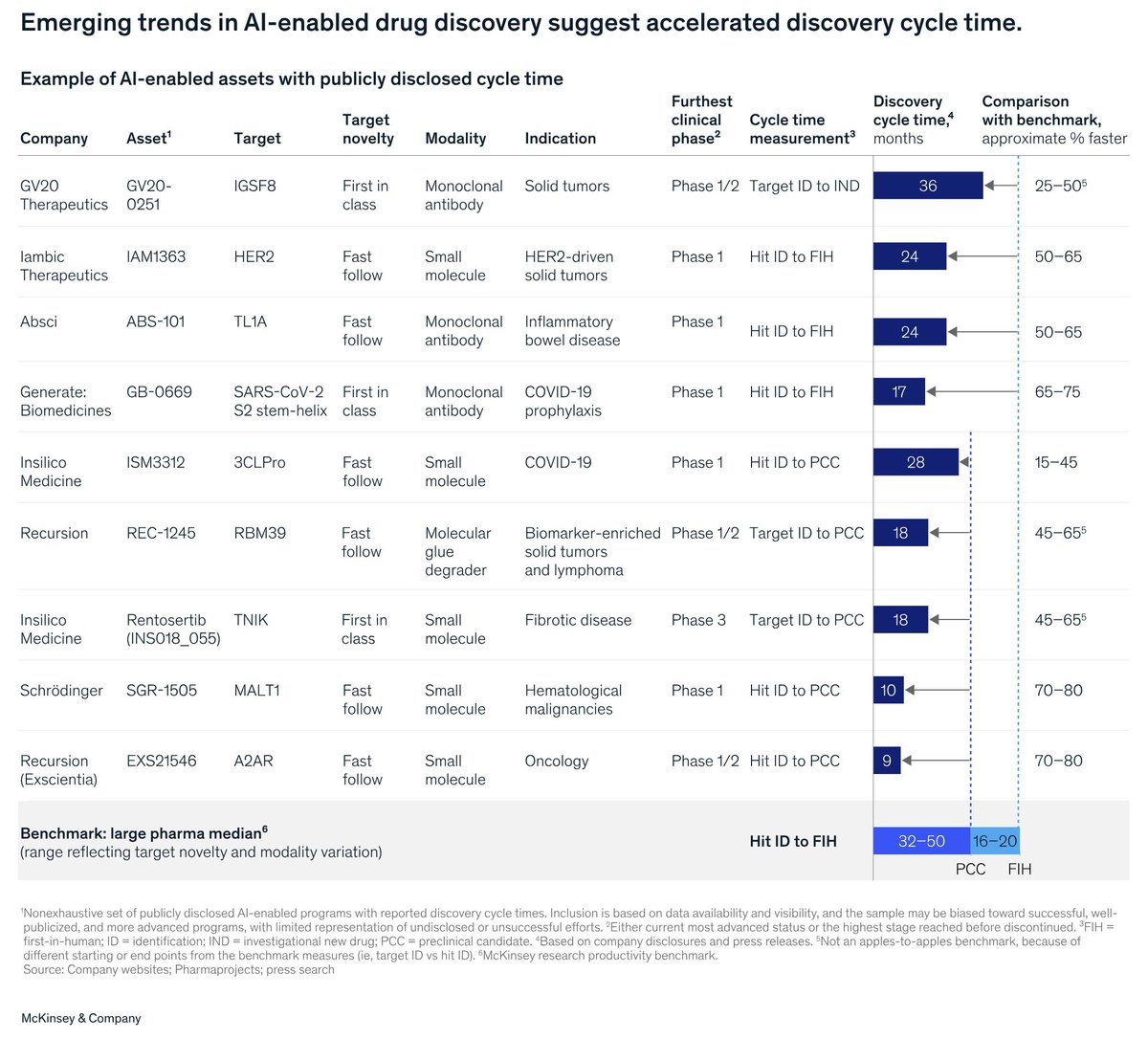
McKinsey compiled nine AI-enabled drug programmes with publicly disclosed timelines. Discovery cycles run from 36 months down to 9, against a large-pharma benchmark of 32 to 50 months from hit identification to first-in-human. McKinsey's conclusion is that these ran 15% to 80% faster depending on target novelty and modality.
The nine are not measuring the same stretch of road. Some run from target identification to a regulatory filing, some from hit identification to first-in-human, and the two fastest stop at a preclinical candidate, a stage whose large-pharma benchmark is 16 to 20 months rather than 32 to 50. McKinsey flags in its own footnote that this is not an apples-to-apples comparison.
A second footnote matters more. The sample is skewed toward successful, well-publicised programmes, with little representation of discontinued work. Part of why the speeds look impressive is that the slow ones are not on the table.
The hardest information sits in the furthest-clinical-phase column. Eight of the nine are in Phase 1 or Phase 1/2. The only one in Phase 3 is Insilico Medicine's rentosertib, an oral small molecule for idiopathic pulmonary fibrosis, which dosed its first patient at Peking Union Medical College Hospital on 9 September.
The money and the failures in drug development have never been in discovery. They are in the clinic. AI has genuinely compressed the front end, and the front end was always the cheap part. The real answer arrives when a Phase 3 reads out.
Source: McKinsey AI drug discovery research, Insilico Medicine announcements and the US clinical trials registry (Image: @glocalinvestor)