【這張被當成 AMD 勝利的圖,左半邊寫的是相反的事 🔍】
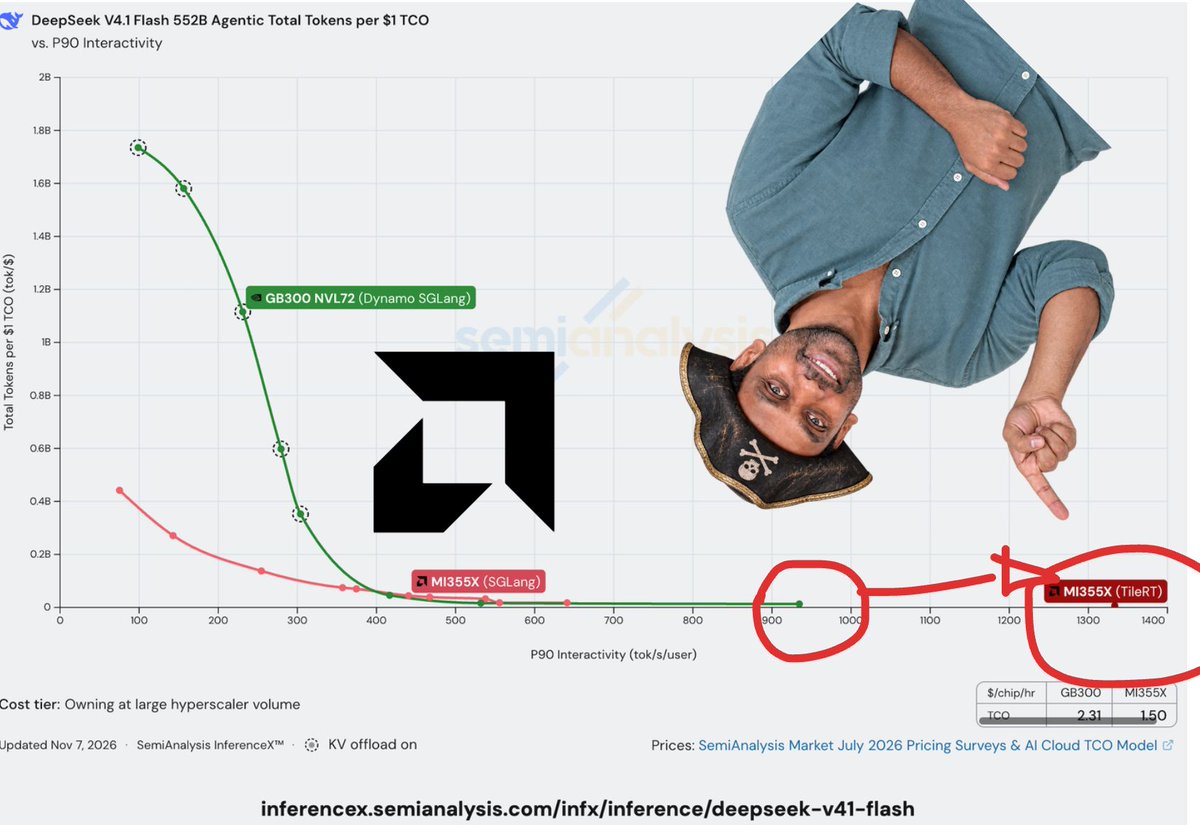
橫軸是每個使用者每秒能拿到幾個字,縱軸是每一美元的總持有成本換得多少產出。AMD 的那個紅點落在最右邊,被解讀成它追過輝達了。
左半邊不是這樣。在每秒一百字上下這種多數應用實際跑的速度,輝達 GB300 機櫃每一美元約產出 17.4 億個字,AMD MI355X 約 4.8 億,差距三倍以上。同一個站台先前對其他模型的測試也是同樣的形狀:低互動速度時輝達領先近一倍以上,要到每秒一百六十字附近,兩邊才拉近到一成出頭。
AMD 真正做到的是另一件事。搭配 TileRT 軟體之後,它把曲線延伸到每秒一千三百字以上,那是輝達那條線根本到不了的區間。只是在那個速度,兩邊的每美元產出都已經貼近零。
差別其實寫在圖右下角的小表:GB300 每顆每小時 2.31 美元,MI355X 1.50 美元。AMD 贏的是標價,不是晶片吞吐量。
兩個但書。這組成本假設的是超大規模業者的大量採購價,一般買家拿不到;TileRT 那個點目前只有單一來源轉述,還沒有獨立驗證。
為什麼速度這一端值得看?代理式的工作要一步接一步跑完才有答案,使用者等的是整串結果,不是一句話。誰能把高速那一端的成本壓下來,才是接下來的勝負手。
資料來源:SemiAnalysis InferenceX 推論基準頁面與其 DeepSeek 模型跨晶片比較,以及第三方對該機構最新貼文的轉述(圖片來自 @SemiAnalysis_)
The Chart Everyone Read as an AMD Win Says the Opposite on the Left
The horizontal axis is how many tokens each user gets per second. The vertical axis is how much output one dollar of total cost of ownership buys. AMD's red marker sits at the far right, and it has been read as AMD overtaking Nvidia.
The left half says otherwise. At around 100 tokens per second, the speed most applications actually run at, an Nvidia GB300 rack produces roughly 1.74 billion tokens per dollar against about 0.48 billion for AMD's MI355X, a gap of more than three times. The same benchmark site's earlier tests on other models show the same shape: Nvidia leads by well over 100% at low interactivity, and the two only converge to around 13% near 166 tokens per second.
What AMD has actually done is different. Paired with its TileRT software, it extends the curve past 1,300 tokens per second per user, a range Nvidia's line never reaches. At that speed, though, output per dollar is close to zero for both.
The real difference is in the small table in the corner: $2.31 per chip-hour for the GB300 against $1.50 for the MI355X. AMD is winning on sticker price, not on silicon throughput.
Two caveats. These costs assume hyperscaler-volume purchasing that ordinary buyers do not get, and the TileRT reading currently rests on a single relayed source with no independent confirmation.
Why does the fast end matter at all? Agentic work has to run step after step before it returns anything, so the user is waiting on the whole chain rather than on one sentence. Whoever can bring down the cost of serving at those speeds wins the next round.
Source: SemiAnalysis InferenceX benchmark pages and its DeepSeek cross-accelerator comparisons, plus third-party relays of the firm's latest post (Image: @SemiAnalysis_)